

Work needed to boost Pinellas Black student achievement, review says
Tampa Bay Times | By Jeffrey S. Solochek | May 1, 2025
The district has worked to close achievement gaps for a decade after a court-ordered settlement.
ST. PETERSBURG — The Pinellas County school district’s long-running effort to narrow achievement gaps between Black and other students still has a long way to go, leaders of the group pressing for improvement argue.
“Blacks are lower in achievement, higher in discipline referrals,” Goliath Davis, interim president of Concerned Organization for the Quality Education of Black Students, said Wednesday after hearing a report on the latest data. “What does that tell us as a community?”
“We’ve got a lot of work to do,” came the shouted reply from the crowd of more than 100 residents who attended the organization’s presentation at the Enoch D. Davis Center in south St. Petersburg.
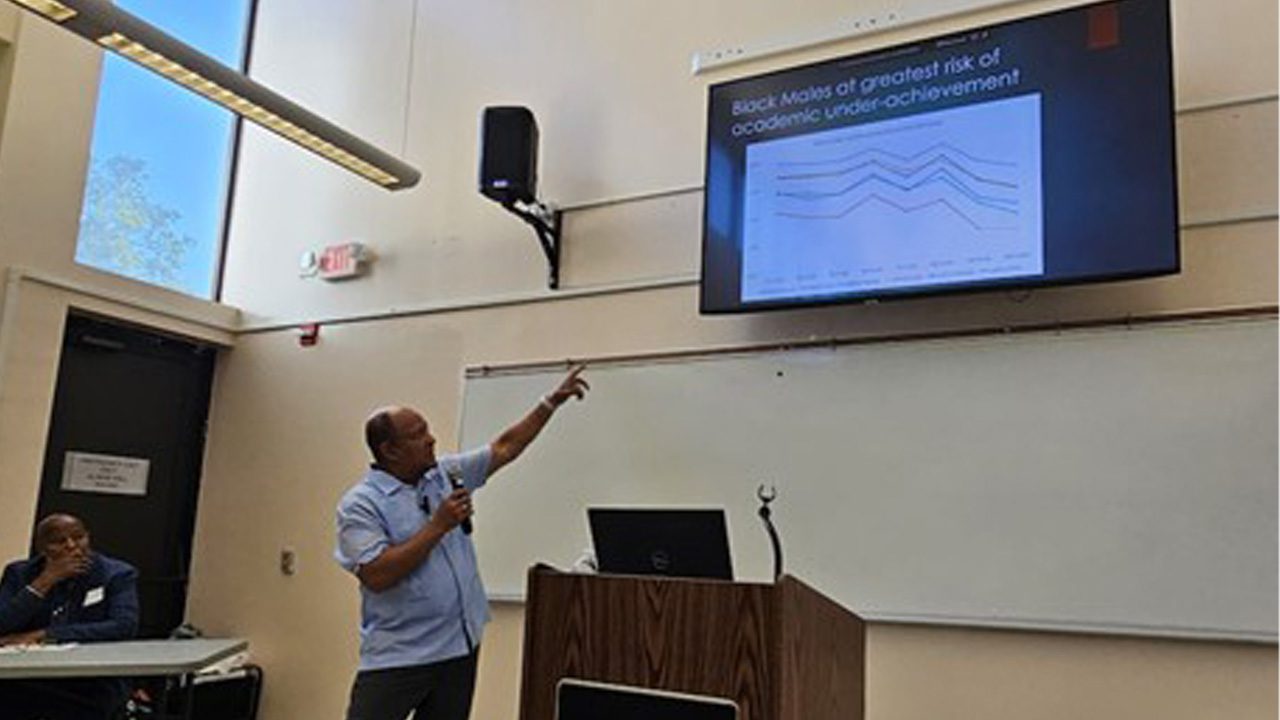
Researcher Oscar Barbarin, a retired University of Maryland professor of psychology and African American studies, offered a roadmap. His review of data underlying the district’s Bridging the Gap plan, crafted in the wake of a lawsuit accusing the district of shortchanging Black students, indicated that some strides have been made.
Black students’ access to advanced courses, for instance, has expanded, Barbarin said. Efforts to increase Black students’ high school graduation rate also have succeeded.
But Black children’s proficiency rates in reading and math have risen only slightly, and “there’s still quite a gap” between Black and other students, he said, with boys at the lowest rung. And “the baseline is not very high,” he added, noting that fewer than 40% of Black youth are at or above grade level.
Barbarin also panned the district’s efforts to mete out discipline proportionately, noting that Black students are twice as likely to be referred to the office, and once they get there, they’re four times as likely to be suspended.
Discipline remains a “major, major problem,” Barbarin said. “School climate and discipline policies require significant additional progress.”
He recommended that the organization should continue its oversight and collaboration with the school district for another decade, updating their goals. He also called on the district to study how students who graduated have performed once in college or working, to determine whether they were well prepared.
The concern centered on the seeming disconnect between high graduation rates and low passage rates on state exams. Davis has repeatedly raised the question in recent years, as student reliance on alternate tests has grown.
As the community pushes the district to do more, Davis said, the community also must do its part.
“As parents we’ve got to do better, as coaches we’ve got to do better, to reinforce those values that we grew up with, that education was a way up and out,” he said, receiving a chorus of supportive voices in response. “We’ve got to do our part to make sure our kids are getting what they need.”
Superintendent Kevin Hendrick, who attended the event, did not shy from the organization’s assessment.
“We have a lot of work to do, and we’d love the community’s help,” Hendrick said. “It’s great to see the turnout and see that people are interested.”
School board member Caprice Edmond, who represents southern Pinellas County, applauded the community involvement and interest. Like Hendrick, she stressed that although additional steps remain, the district has taken steps to improve outcomes, including a heavy focus on early literacy that already has paid dividends with some of the highest elementary reading levels in years.
“I’m glad this meeting occurred, and I hope the momentum continues,” Edmond said.
Hanging over the conversation, though, was the national political climate in which the Trump administration has threatened action against programs and policies viewed as giving an advantage to one group over another. Local NAACP president Esther Matthews asked whether that might hinder these efforts.
Hendrick said he wasn’t concerned, as the district follows the relevant federal and state laws, and its plans adhere to requirements that schools look at all subgroups to improve their academic achievement.
Barbarin added that the state constitution required an equitable education for all, and the district should be on sound legal footing. Political wrangling, he said, is another thing.