

How One High-School Teacher Tells Her Gen-Z Students the Story of Capitalism
The Wall Street Journal | By Heidi Mitchell | September 19, 2025
For Rachel Money, the economic system is more than the definitions. It’s about giving her students the knowledge to understand and navigate the world.
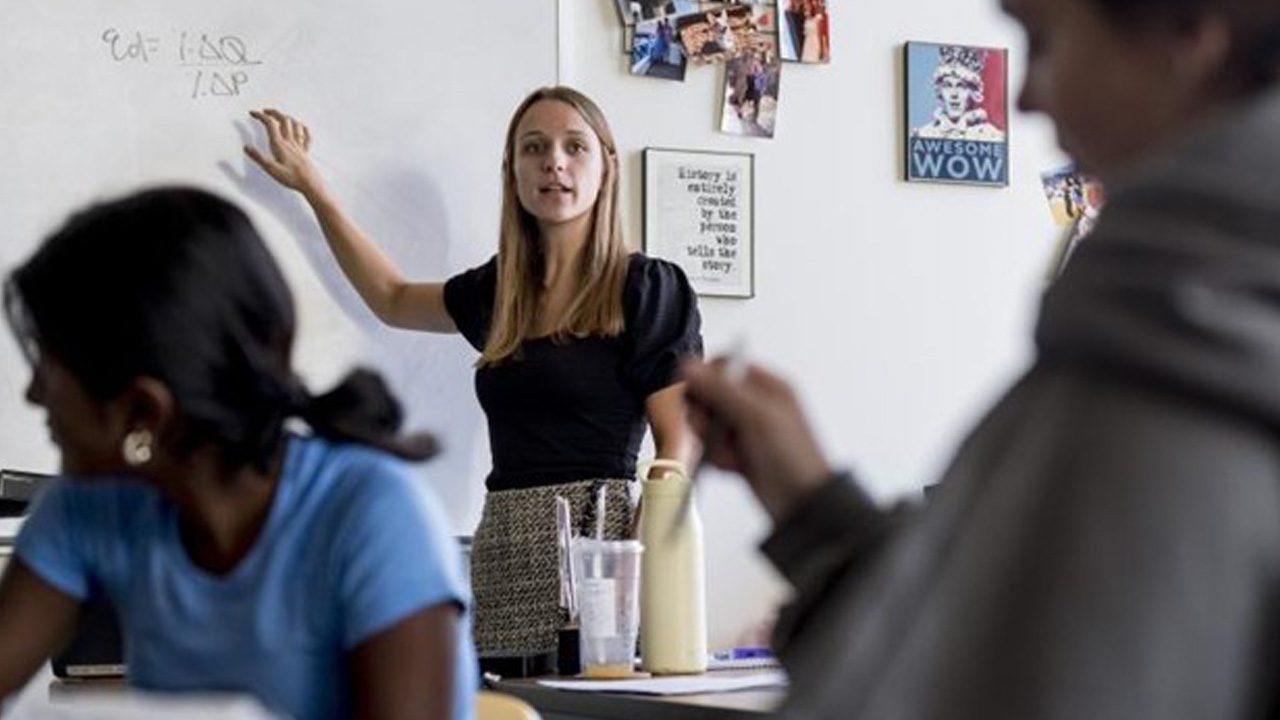
At Parkway West High School in the St. Louis suburb of Ballwin, the aptly named Rachel Money teaches capitalism as part of the curriculum for freshman U.S. History and for juniors and seniors in various advanced-placement classes.
Money doesn’t expect ideological consensus. Her goal is for students to understand how capitalism in America does—and sometimes doesn’t—work, while building the skills to analyze, question and compare other economic systems. And she only has a few lessons in which to impart all that wisdom.
The Wall Street Journal spoke with the 26-year-old teacher about what economic issues resonate with Gen Z and how students are thinking critically about the system they are inheriting. Edited excerpts follow:
What is capitalism?
WSJ: How do you introduce capitalism across your courses?
RACHEL MONEY: The definition I give students is that capitalism is an economic system where there is private ownership of the means of production. Depending on the class, we sometimes discuss Adam Smith and the idea of the “invisible hand” of the free market. With my economics students, they often want to know if the invisible hand works. I have some students who believe that, if economic conditions are negatively impacting citizens, the government should take action rather than wait for the economy to self-correct. Others prefer laissez-faire capitalism.
WSJ: Do you contrast capitalism with other economic systems?
MONEY: Often students have never really learned about economic systems other than that of the U.S. and become interested in learning more about different approaches. There was a moment in my first year of teaching economics when one student announced that they believed socialism was great. Initially, a lot of the students were pushing back. They brought up examples of when socialism had been tried and ended up failing. Eventually, what started as a passionate debate became a thoughtful conversation focused on whether there was a way to ensure the basic needs of individuals were met while encouraging things inherent to capitalism, like innovation.
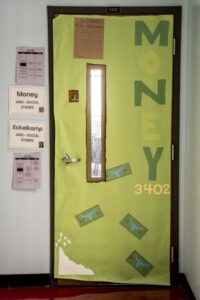
The door to Rachel Money’s classroom.
Monopoly, with a twist
WSJ: Do you introduce any activities or games to makes the stakes feel real?
MONEY: To discuss the impacts that wealth and resources can have, we play Monopoly, but in our version, I randomly assign each person a different income. So, each student starts with different amounts of money, and collects a different income each turn, but the goal of the game is still the same as classic Monopoly. During the last game, I heard a lot of, “That’s not fair!” or, “How am I supposed to be able to afford anything if I don’t make as much?” from the students who started with less money. After playing the game, the class debriefed on what impacted their chances of success in the game, who the game was easiest for and how this version of the game might relate to the real world.
A lot of groups mentioned the advantage that the “wealthy” players had in this game, as they were able to buy properties from the start. They noted that by the time the players with the lowest incomes accumulated enough wealth to purchase a property, many of the properties had already been taken and had houses or hotels placed on them. That, they realized, further disadvantaged the player because they couldn’t profit off charging rent in the same ways some of the other players were able to, and at the same time they had to pay increasing sums of money to the others.
WSJ: Any other activities?
MONEY: In my AP Econ classes, when we discuss the budget and the deficit, I put the debt clock on the board and we take time to not only watch the number rise but to compare the data to years past and look at future projections.
Students are usually aware that there is a national debt going into this lesson, but seeing the actual numbers changing in real time is something that sticks with them. They like to look at the debt at multiple points in history and discuss what may have contributed to changes in the debt over time. When we look ahead at debt projections, students express their concern about the growing debt and want to know if there is a plan to decrease it. This lesson usually gets students to think about where the country is economically, how the government is spending money and if they agree with that. A lot of students are shocked when they see, for the first time, the amount of money that is budgeted for military spending.
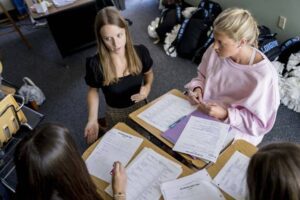
Rachel Money with students Andrea Restrepo and Ella Wheeler during class.
Act like a muckraker
WSJ: Is there any unit that alarms your students or has them changing their minds?
MONEY: My freshmen students are always appalled as we discuss working conditions and pay during the Industrial Revolution and the Progressive Era and want to know why nothing was done sooner to make things better. One activity that is somewhat of a turning point would be while reading an excerpt from Upton Sinclair’s “The Jungle” that looks at the dangers of the workplace and the lack of regulation, including safety and health standards, in industry at that time.
As we learn about the different individuals who contributed to raising awareness of the problems and bringing about change, students see the difference that citizens can make.
For the related assignment, I have students act like muckrakers and write an article “exposing” a modern-day issue. Students like this because it takes the approaches they know people have historically used to bring about change, but it gives them a chance to explore current issues they care about and learn more about how to shape the world they live in. I have seen papers on issues in sports such as pay disparities between male and female athletes or concerns with safety standards and health protections for athletes. I have seen papers that focus on issues such as homelessness. Students not only gain awareness of modern issues that exist, but they are also asked to research what is currently being done to address the issue and to propose their own ideas about what should be done.
This past year two groups of AP Micro students did a project on the economics of Taylor Swift’s “Eras” tour, and connected the tour to multiple economics concepts such as externalities and Ticketmaster as a monopoly. They evaluated Ticketmaster and its business practices, the benefits/costs that large concerts can bring to an area and how other businesses earned money as more people traveled to the city for the concert. The focus was more on the tour itself, though there was some discussion in class about the way Taylor Swift, a billionaire, gave the tour staff bonuses.
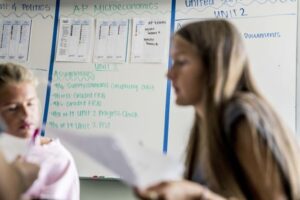
Students Ella Wheeler and Diana Chocheva work on an assignment in Rachel Money’s class.
WSJ: Do you use current political events to enhance your classroom conversations?
MONEY: Yes! Whenever something related to our class, like tax cuts or changes to environmental regulations, shows up in the news, it creates that bridge to help students discuss capitalism as something that impacts their lives.
When Trump began to propose tariffs, for example, they came into class wanting to talk about the negative impacts tariffs would have on consumers and wondering why he was talking about tariffs as if they were a great thing.
My class had a lot of outspoken critics about the current administration. I had students who were very honest about their negative feelings on the position Musk held within the government and they criticized DOGE.
WSJ: Are students obsessed with wealth, the wealthy or being wealthy?
MONEY: My ninth-grade students are more likely to be impressed by symbols of wealth. Some are really impressed when they learn the net worth of a CEO or learn that the CEO has a private jet or boat. On the other hand, with my 11th- and 12th-grade students, a lot are concerned with choosing a job that will allow them to live comfortably.
WSJ: What is your goal for your students?
MONEY: Students need to understand concepts like GDP, fiscal policy and so on to pass their AP tests. But in addition to that what I want is for them to leave feeling empowered—to have conversations outside of class, to advocate for what matters to them and to be informed citizens who know their own beliefs and can shape the future they want to live in.
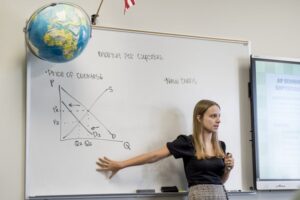
Rachel Money says she tries to prepare students to inherit the world someday.
The upperclassmen are going off to college or trade school or starting a career and have to make real-life decisions. They’ll be able to vote. So giving them those real-world tie-ins, whenever possible, to allow them to evaluate the reality of the country they live in, to support or criticize it or to propose something different, is critical.
Helping students feel a sense of agency is important. They are aware that they are one day going to inherit responsibility for the world we live in, and be tasked with responding to consequences of decisions being made by current leaders.