

How could Florida union law change SW Florida teacher, worker rights?
A sweeping new state law could soon reshape how public sector unions operate across Southwest Florida.
Lawmakers approved Senate Bill 1296 earlier this month, setting new requirements for unions representing teachers, nurses and municipal workers. The measure now heads to Gov. Ron DeSantis’ desk and is set to take effect July 1.
The changes come amid ongoing contract disputes and political friction in Lee and Collier counties.
What will Florida’s new union law change for teachers, workers?
The legislation sets stricter rules for most public employee unions, with police and firefighter unions largely exempt.
Under the new law:
- Unions must maintain at least 60% dues-paying membership or face recertification
- At least 50% of all eligible employees must participate in that vote
- A majority of those voting must support the union for it to remain certified
If a union fails, it loses its certification and cannot reapply for a year, leaving employees without formal representation during that time.
The law would also limits paid “release time” for union work unless unions reimburse the employer, and doubles fines for illegal strikes from $20,000 to $40,000 per day.
Supporters say the changes make sure unions actually reflect their members. Critics say the structure makes it easier for unions to be dissolved, especially because non-voters effectively count against them.
State Rep. Jenna Persons-Mulicka listens to public comment during a special meeting to rediscuss a memorandum of agreement between United States Immigration and Customs Enforcement and the Fort Myers Police Department at Fort Myers City Hall in Fort Myers, Fla., on Friday, March 21, 2025.
Why did Lee County lawmakers back the union bill?
The bill was driven by lawmakers who represent Southwest Florida: Sen. Jonathan Martin and Rep. Jenna Persons-Mulicka.
To support the bill, Martin pointed to a conflict in Lee County, where the teachers union filed an unfair labor complaint against the district over a plan to offer incentives for teachers to transfer to lower-performing schools.
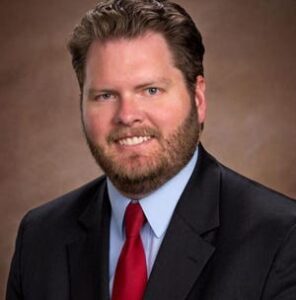
State Sen. Jonathan Martin represents District 33 in the Florida Senate.
“What I saw in Southwest Florida disgusted me. We had kids who have one shot at the American dream and teachers in Lee County getting in the way of those kids’ success and opportunity,” Martin said.
He has argued the bill ensures unions answer to the majority of workers rather than a smaller, more active group.
When asked why police and firefighters were exempt from many provisions, Martin said, “Some put on bulletproof vests when they go to work. Some don’t.”
How are Lee, Collier unions reacting to SB 1296?
In both Lee and Collier counties, union leaders say the law could weaken their ability to advocate for workers, not just teachers, but public employees across cities like Fort Myers, Cape Coral and Sanibel.
David Jimenez, president of the International Union of Painters and Allied Trades Local 2301, which represents utility and public works employees in Cape Coral and Fort Myers, warned lawmakers the measure could affect workers responsible for essential services.
“We have a major concern because we feel as though this bill infringes on our constitutional rights and our freedoms that myself and other veterans who in this room spent time away from family and friends to keep,” Jimenez said during a Senate committee hearing. “This bill impacts my coworkers, myself, my fellow veterans, and the way we provide for our families.”
Jimenez noted that many of those workers are veterans and provide critical infrastructure like safe drinking water. Local union leaders say those employees, who are not classified as public safety workers, would face the same stricter certification rules as teachers under the bill.
In both Lee and Collier counties, teachers union leaders say one of the law’s most debated provisions, requiring at least 50% of eligible employees to participate in recertification votes, is not an immediate concern.
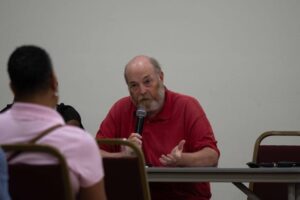
Kevin Daly, president of the Teachers Association of Lee County, speaks with community members during an education town hall at the Quality Life Center of Southwest Florida in Fort Myers on Oct. 27, 2025.
The Teachers Association of Lee County and the Collier County Education Association both report membership levels above the 60% threshold that would trigger such an election, meaning they are not currently subject to the new voting requirement. Union leaders in both counties say they expect to remain above that mark, though they acknowledge maintaining those numbers could become more difficult over time.
Kevin Daly, president of the Teachers Association of Lee County, characterized the legislation as a targeted attack that prioritizes politics over the actual needs of Southwest Florida residents.
“It just seems like in a time where gas is now getting more expensive, groceries are more expensive, there’s a cost of living crisis here in Southwest Florida for everybody… instead of taking their time to address these problems of the working people and their constituents, they have decided to target public sector unions,” Daly said.
In Collier County, where teachers are already at an impasse with the district over pay, the law arrives as frustration is boiling over.
Kenneth Mouton, president of the Collier County Education Association, CCEA, said the district declined to help cover the cost of an official transcript needed to move the impasse forward.
“The District declined to expedite the impasse process by sharing the cost with CCEA to obtain the court transcript sooner. The attorneys require the transcript in order to prepare their post‑hearing briefs for the special magistrate.”
Without the transcript from the impasse hearing, the special magistrate cannot move forward with a decision, further delaying the process and teacher pay.
Mouton explained that teachers in Collier are still working under pay terms negotiated more than a year ago, with no resolution in sight. Mouton warned that without union representation, educators could also lose benefits secured through collective bargaining, including district-paid health insurance, a cost he said could otherwise fall directly on teachers.
“They have literally turned their backs on people that put them in office,” Mouton said of elected leaders. “It’s a money-making business right now. ‘Get the unions out of the way, open the door, so we can do whatever we want to do.'”
He urged residents to stay engaged, adding that elections carry consequences and voting decisions should reflect workers’ livelihoods, not just party affiliation.
The Collier County School District responded to The News-Press & Naples Daily News requests for a statement but said it does not comment on pending legislation until it is signed into law and noted that questions regarding the current contract impasse must be addressed through the formal hearing process.
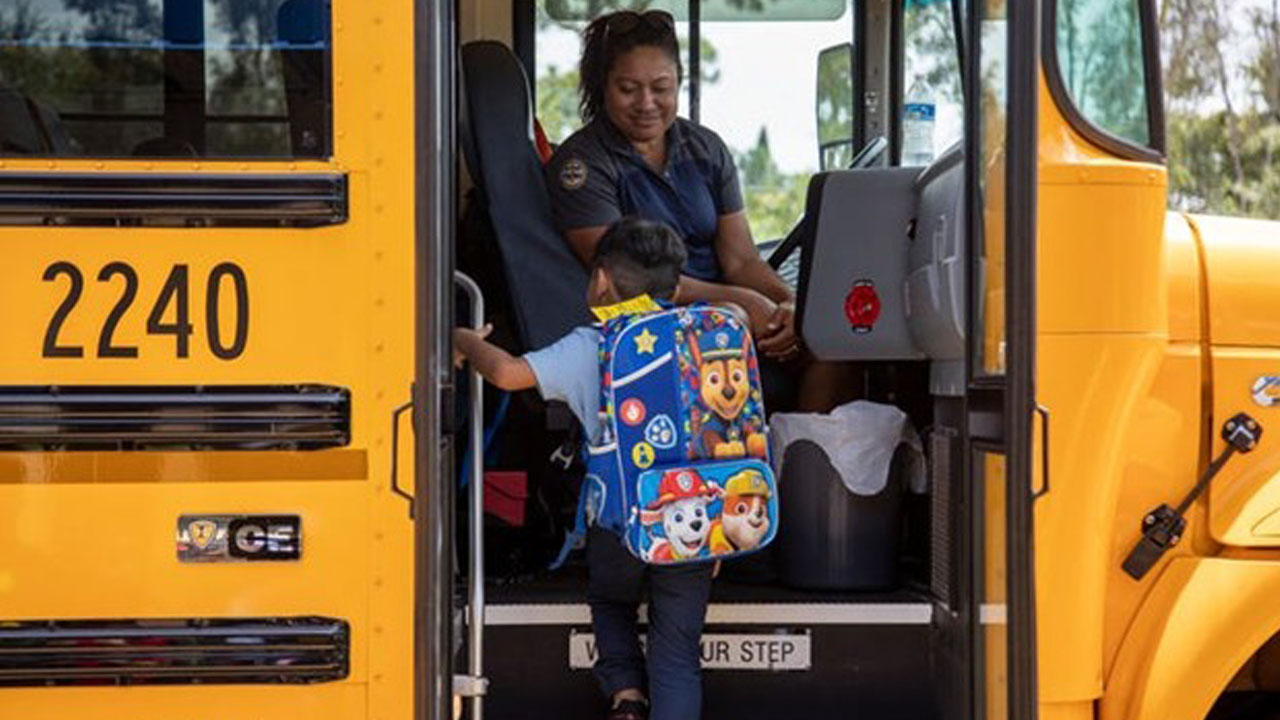
A student gets on the bus after his first day of school at San Carlos Park Elementary School on Wednesday, Aug. 10, 2022.
New Florida law would set fast timeline for teacher pay talks
One of the more immediate changes affects how quickly districts and unions must negotiate pay.
The law classifies state-funded salary increases as a “financial urgency,” requiring both sides to meet within 15 days of the state budget taking effect July 1.
That timeline has raised questions, as many districts don’t finalize enrollment numbers or budgets until later in the summer.
Lee County officials say they’re prepared.
“The School District of Lee County begins its bargaining process earlier than most districts across the state. Both parties are committed to meeting the deadlines required under the new legislation. Because the state budget has not yet been finalized, specific dates have not been set, but we do not anticipate any disruption to that process once they are,” the district said in a statement.
Still, union leaders argue the timeline could force rushed decisions on pay before districts have a full financial picture.
Did unions organize Lee County student protests?
The legislation also gained traction amid political fallout from student walkouts in February. In Lee County, roughly 3,400 students at 14 of the district’s 84 schools walked out, according to district estimates in February. After completing its disciplinary review, the district said Feb. 26 it plans to discipline 2,480 students who violated the Student Code of Conduct during the walkouts.
Some state officials suggested unions played a role in organizing those protests. Those claims haven’t been backed up locally.
While speaking about his bill, Martin said, “I’ve heard accusations from just my district in Lee County that school teachers were helping organize political speech and a walkout with some of my constituents and students at those schools. We don’t want the individuals who are members of the union to use state resources, government resources, tax dollars to push their political messaging or their extracurriculars, and that’s the point of the legislation.”
“There is no evidence of that,” Daly said.
Superintendent Denise Carlin has said she has no evidence that teachers or unions were involved.
At the state level, Florida Education Association President Andrew Spar also pushed back.
“The Florida Education Association has never encouraged or organized and would never encourage or organize students to walk out of class or miss instructional time for student protests. Period. Instructional time is invaluable. Every educator knows that we value every minute of our students instructional time in their classroom and the focus on learning,” Spar said.