

What do Miami communities lose when a school closes? Rainbow Park has an idea
Miami Herald | By: Austin Horn | August 11, 2026
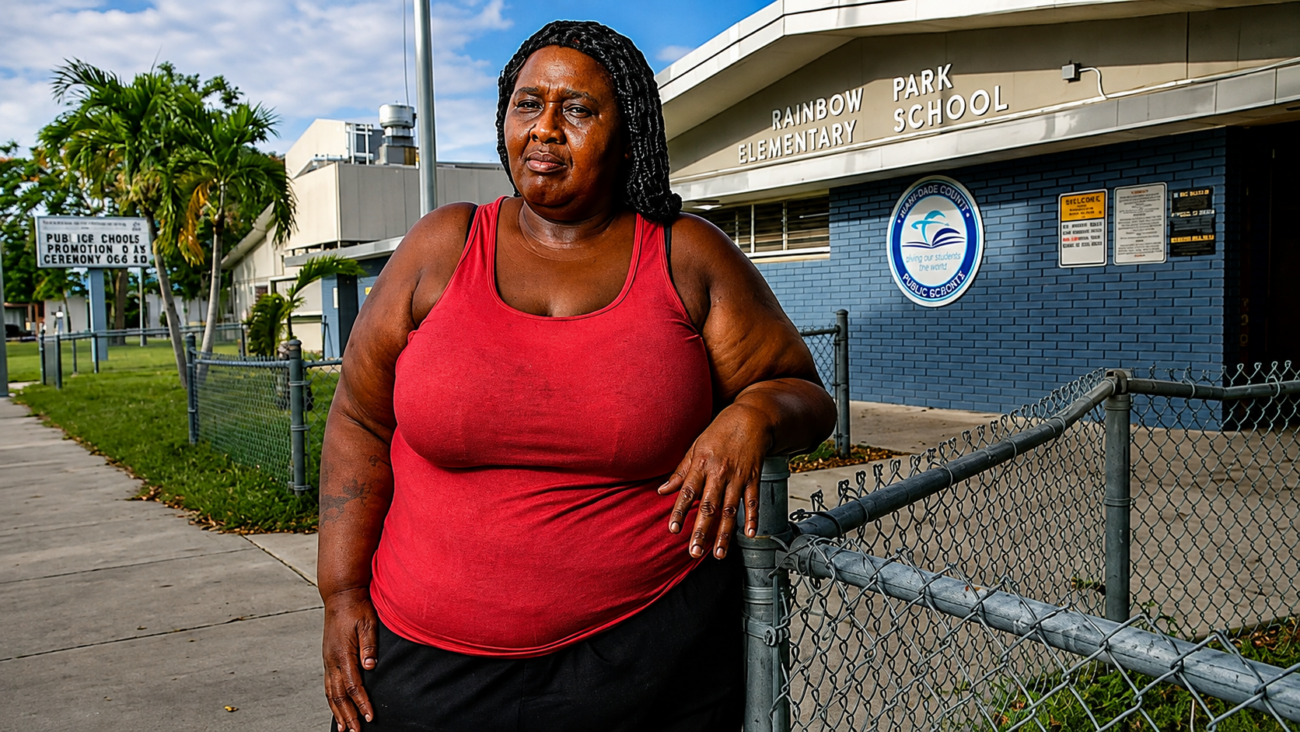
Crystal Walker sat with her parents in Rainbow Park Elementary’s cafetorium last summer, watching her third-grade daughter dance in an end-of-year showcase on a stage known to all three generations of the family. “It was a full-circle moment,” Walker said, “because we all sat right there in that cafeteria, one time or another, eating breakfast or lunch.”
First-graders in tutus twirled and bent into plies to Whitney Houston’s “Greatest Love of All,” showing off what they’d learned in the school’s dance-magnet program. Older students leapt across the stage to fast-paced R&B songs. A troupe donned cowboy attire and brought the crowd to its feet as they stomped out the beat of a country-infused pop hit.
Walker, 40, called it “a legacy memory.”
Now, the Rainbow Park experience as they knew it will remain just that: a memory.
Seventy years after it opened its doors to the community, Rainbow Park was one of nine underpopulated schools closed or consolidated this summer by Miami-Dade County Public Schools, which is facing steep enrollment declines and resulting financial pressures. District leaders have signaled that more cuts are likely to come.
Seven of the nine shuttered and consolidated institutions had majority-Black populations, even though Black students make up about 20% of enrollment in district-run schools. The same trend is evident throughout the county, where 22 of the 30 schools with the lowest utilization rates are located in Black communities, placing them on the front end of a problem being felt throughout South Florida.
“There was real potential at the school,” said Walker. “Now, it just feels like a defeat. It feels sad.”
In February 2016, Rainbow Park Elementary had 409 students; ten years later, it had 151, per district data. Last year, almost three quarters of Rainbow Park’s campus was unused, according to a state estimate. Most of the other schools closed or merged saw similar declines.
The pressures to close schools like these are intense. Fewer students means less taxpayer money for schools, which Superintendent Jose Dotres says threatens to short-change kids.
Closures allow the district to cut spending on building upkeep and reduce its biggest expense — staff count — without explicitly laying employees off. Plus, moving students from under-enrolled schools to bigger ones allows the district to provide them with more services like extracurriculars and specialty classes.
Jude Bruno, the new president of Florida’s statewide Parent-Teacher Association, has seen it from both sides. He was an alternate on the committee responsible for boundary changes and closure recommendations last year, and his child’s Miami Gardens school was placed on the “initially advised” list, essentially warning that it may close or merge soon.
“We had to make the decision of, ‘Do we … run the risk of moving him if they decide to close that school, or do we bite the bullet and do that now?’ I’m dealing with that reality,” Bruno said.
But he understands it.
“The district, as they’ve shared and I’ve agreed, has the responsibility to evaluate how they use resources. There’s no winning in this conversation,” Bruno said.
The Community impact
Rainbow Park’s closure is in some ways a flash point in the story of a changing neighborhood molded by economic and social pressures.
The school anchors a triangle-shaped neighborhood southwest of the Golden Glades interchange where the streets are lined with short palm trees, laurel oaks and single-family houses, modest and colorful. At one point, it was filled with big families, though those days are mostly gone.
“The district said even if every household that was in Rainbow Park’s current boundaries went to Rainbow Park, it still wouldn’t be over 50% utilized,” Walker said. “Fortunately or unfortunately, people are having fewer kids now. It’s just not as populated as it was.”
Shelle Higgs, who grew up in the neighborhood and can see the school’s front door from her house, describes the community where she was raised like something out of a Norman Rockwell painting.
Higgs, a 43-year-old Publix employee, grew up walking to Rainbow Park. Her uncles attended the school, and she knows many other parents thanks to the walks to and from campus. She can still rattle off the names of her teachers from Kindergarten through fifth grade.
The school has even grown up with her: Her children’s Rainbow Park principal was the daughter of her old principal.
Now, when classes resume on Thursday, her two youngest will attend Bunche Park for 4th and 5th grade. It’s not far — 0.7 miles North as the crow flies — but getting there involves crossing busy 22nd Avenue, which makes a mother worry.
“I wish I could just put all the kids that stayed in this neighborhood at the one school down the street from my house so they could reopen back up. I feel like it was better and self-sufficient for the ones who stayed in this neighborhood because now you have to get up in the morning and get in your car, drive your kids around the corner, down the street, deal with traffic,” Higgs said. “You used to walk your kid to school. It [built] a sense of being bonded with your kids.”
An aerial view of Rainbow Park Elementary on Wednesday, July 22, 2026. The public school, located in Miami Gardens, is in a large suburb setting.The school is one of nine public schools recently closed by Miami Dade County.
Asheley Hepburn did not attend Rainbow Park, but the pastor of Magnolia Park Church of Christ — located just a couple blocks from the school — knows all about it from his church membership.
“Their responsibility is making sure kids get educated, and to be able to do it within budget. So, I get it,” said Hepburn, a former budget director for St. Lucie County. “But are some of the members of my church happy? No.”
Academic effect
There is some evidence that school closures can be harmful to students.
A study from Houston University economics PhD Jeonghyeok Kim analyzed over 300 school closures in Texas. It found that, by age 26, those students who experienced a school closure were 1.8 percentage points less likely to graduate from high school, 1.4 points less likely to attend college and 1 point less likely to be employed.
Other studies — including two from the University of Chicago’s Consortium on School Research — have shown modest short-term and long-term negative effects, but also note that outcomes are most reliant on where students end up afterward. In Miami-Dade’s case, that has been the most common message from the administration: These are difficult decisions, but we’re sending students to places with better resources.
“When we have to consolidate a school, we do it because, yes, [it’s] under-enrolled. But what that under-enrollment creates, it creates a school that is less resourced,” Dotres, the district superintendent, said in an interview earlier this summer. “That’s basically the trigger of the majority of the decisions that go into when we have to consolidate schools.”

Superintendent of Miami-Dade County Public Schools Jose L. Dotres, right, speaks with Principal James Dominique, left, during the first day of school at Miami Edison High on Thursday, August 15, 2024, in Miami, Fla.In Rainbow Park’s case, the students going there last year have been assigned to higher-performing elementary schools.
Fourth graders at Rainbow Park posted state reading and math assessment scores well below the state average. Now students previously assigned to attend Rainbow Park will be assigned to Bunche Park Elementary, which outpaces Rainbow Park in both exams, and Robert B. Ingram Elementary, which tests better than both and easily clears the state average in reading.
Both were rated “A” schools by the state in 2026, while Rainbow Park was one of relatively few in the district given a “C” grade.
The demographic correlation
The loss of a school is something most community members can feel. Northwestern University Professor Sally Nuamah worked to quantify it in her book, “Closed for Democracy: How Mass School Closure Undermines the Citizenship of Black Americans.”
She counts a school as a true resource for a community, and in the case of a public school, it’s not one the community is likely to ever get back once it’s gone. A closure is, she says, the “last nail in the coffin” of a withdrawal of public services from Black communities.
It’s not just racial categories that correlate with school closures.
Of the five schools that are closing, all are majority Black and are less affluent than the average traditional public school. At all five, at least two-thirds of students qualify for free or reduced lunch — well above the roughly 52% district average.
It’s also true that schools with higher free and reduced lunch populations are more likely to be under-enrolled.
In the cities Nuamah closely studied for her book, such as Philadelphia and Chicago, closures disproportionately happened in schools that were in Black, less affluent neighborhoods. She said that’s no coincidence.
“These people don’t have bad intentions, theoretically. But I think politics reminds us about who matters, who is important, who the state is serving. The state has a lot of people they’re serving, but all the people they’re serving aren’t equal,” Nuamah said.
Bruno, who is the first elected Black man and Haitian American to his position, has a somewhat different view than Nuamah.
He said he believes the closures and consolidations have been “purely on the numbers” and aren’t intentionally targeted towards Black communities.
Bruno guessed that the district’s increased emphasis on magnet schools may have hurt enrollment at some predominantly Black schools, but he says the issue “boils down to” cost of living. Those schools may not be losing population to charter or private schools as much as they’re losing them to nearby counties, the Orlando area or other states.
“[Much] of our urban core and Black population is in the north. If they’re not finding opportunities here, they’re moving north and north and north until they find them,” Bruno said.
Charter schools may not play as big a role as some would guess. At just 7.6%, charter schools have a much lower Black student population than traditional public schools, which are 20% Black.
Whatever the reason, enrollment loss as well as closures and consolidations have been most stark in Black communities thus far.
Rafael Villalobos, South Region superintendent and the school board’s recent pick to replace Dotres later this school year, told the Herald the district prioritized numbers over demographics.
“We looked at those schools that were at 200 [students] or less, and unfortunately they fell in many of those neighborhoods,” Villalobos said.
But the next round of schools he said will likely be under consideration — those with 250 to 350 students in buildings that could fit 1,000 or more — casts a wider demographic net. Currently, the district’s student body is more than 70% Hispanic.
The school closure process
So far, neighborhood efforts to stop school closings haven’t yielded many results.
Walker, whose youngest child is now set to attend Scott Lake Elementary this year, learned that firsthand.
She only got involved at the behest of a friend, a Rainbow Park cafeteria worker, who frantically approached her before school started one morning.
Shoving a piece of paper into her hands about an upcoming meeting by a district committee that reviews school boundaries, she told Walker she’d heard that the district would close Rainbow Park if nobody registered to attend.
So, Walker went to her first Attendance Boundary Committee meeting. The first thing she noticed was the jargon — schools were on “targeted” and “advised” lists without explicit explanations as to what that meant.
Walker compared it to the popular 1998 movie “Armageddon,” where the government kept secret from the public a massive asteroid headed for earth.
“The government didn’t want the people to know, so they didn’t create a big frenzy – that’s what it felt like. I don’t think they did their due diligence to put the terms of what’s going on with these schools in layman’s terms and parents’ terms, so that we can really get a grasp as to what is going on and try to take some type of action,” Walker said.
During one committee meeting, Walker, a registered nurse by trade, showed up with one other parent from Rainbow Park. She took note of the many parents who showed up from Air Base K-8 Center, a sought after magnet school near the Homestead Air Reserve Base.
The committee was not proposing to close Air Base. Rather, it was recommending that Air Base middle schoolers move into a building on the nearby campus of Mandarin Lakes K-8, a majority-Black school that the committee moved to close, to accommodate more seats for its “international magnet” programming.
The parents, teachers and community members who spoke were not in favor.
One grandparent told the committee that “disrupting the student body risks compromising academic progress, school culture and family engagement.”
A teacher said the school “represents what the district should be replicating, not risking.”
Walker, in her testimony to the committee, noted that the Rainbow Park community was upset — the alumni Facebook page reflected as much – but that meetings to air those grievances weren’t accessible.
“We’re from a working-class community. These meetings… they’re not where a lot of parents are able to make these. I had to take a PTO day to even be here today,” Walker told the committee.
The committee later revised its plans for Air Base, instead moving the entire student body to the slightly bigger Mandarin Lakes campus.
It did not move off its plans to close or consolidate any of the nine schools.
As for Rainbow Park, the school’s dance magnet program will live on at Robert B. Ingram Elementary about a mile away, and its campus may not be dormant for long: The district is now in talks with the South Florida School of Excellence to manage what would be a new private school there specializing in autism education.