



Drop in Federal Oversight Hurts Efforts to Improve Absenteeism, Watchdog Says
The Education Department’s process for calculating chronic absenteeism rates also produces unreliable data, according to the Government Accountability Office.
The 74 | By: Linda Jacobson | September 24, 2026
Education Secretary Linda McMahon visited the Cleveland Browns’ training facility earlier this month to join the NFL team in recognizing students with excellent attendance. She used the event to talk about one of the biggest challenges facing U.S. schools.
“Chronic absenteeism is a problem across the country,” she told a reporter.
But actions by the department she leads could leave the public without accurate information on whether schools are making any progress in getting kids back into the classroom, according to a new report from a federal watchdog agency.
The Department of Education this year suspended key efforts to closely track whether states are meeting education requirements of the Elementary and Secondary Education Act, including those related to chronic absenteeism, according to the Government Accountability Office. Those core department functions ensure that federal funds, particularly in schools serving the neediest students, are used properly.
“By significantly curtailing the scope of fiscal and programmatic monitoring, especially for Title I, given the size of the program relative to other ESEA programs, Education has left over $18 billion in federal funding at heightened risk for undetected waste, fraud, and abuse,” GAO said.
The department also uses a formula for calculating chronic absenteeism that produces unreliable data, only making it harder to “identify schools struggling the most,” the report said.
In a response to GAO, Kirsten Baesler, assistant secretary of the Office of Elementary and Secondary Education, said officials still conduct some reviews of whether districts and schools follow the law and plan to announce a new monitoring system this fall. But she rejected two of the GAO’s three recommendations for resuming oversight and revising how the department collects chronic absenteeism rates.
“While we were in a transition year and have not carried out consolidated monitoring, we continue to monitor across ESEA programs,” she wrote.
During its 2013-14 data collection, the Education Department’s Office for Civil Rights was the first to define a chronically absent student as one who misses at least 15 days of the school year. Then, the Every Student Succeeds Act, which passed in 2015, changed the definition to missing 10% of the school year.
Most states now include chronic absenteeism as an indicator of school quality in their accountability systems. The department is supposed to monitor whether those states include the data, broken down by race and other categories, in their state report cards for the public. The agency is also required to collect chronic absenteeism data for all states.
Members of Congress, both Republicans and Democrats, asked GAO for the report, which shows that between 2019 and 2025, the department reviewed chronic absenteeism requirements in 26 states.
That’s insufficient, said Nat Malkus, a senior fellow at the conservative American Enterprise Institute who tracks chronic absenteeism and conducts research on strategies to improve it.
At the current pace, “states might expect a review once every 15 years,” he said. Even if the department resumed monitoring, it “won’t be transformative.”
State efforts, like real-time dashboards, awareness campaigns and early warning systems have been more effective at lowering rates than federal action “by a mile,” he said.
Carl Felton III, a policy analyst at EdTrust, a left-leaning advocacy group, agreed that there was room to improve the federal monitoring process. “But to back off doesn’t put us in a better position to help students,” he said.
‘39 months older’
Recent data from 44 states and the District of Columbia shows that 22.6% of students were chronically absent in 2025. That’s a 1 percentage point improvement over the previous year, but overall, progress has slowed. Many districts, like New York City, Detroit and Portland, Maine, still struggle with rates of 30% or more.
Malkus has long been frustrated with the untimeliness of the federal data. EDDataExpress, an Education Department website, has rates from 2022-23.
“That most recent data is 39 months older than the end of the school year, and counting,” Malkus said. Even if the Trump administration wants to hand more authority over to states, he said an appropriate role for the federal government is to get data out earlier. “I am two-plus years ahead of [the Education Department] without the leverage, or the responsibility, they carry.”
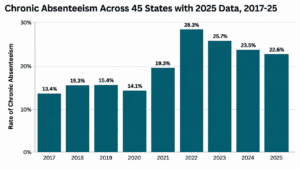
Chronic absenteeism rates have been declining, but are still above pre-pandemic levels.
The GAO report also noted that the department uses a formula that leads to some “overstated and implausible chronic absenteeism rates.”
Before the Biden administration left office, staff began the process of revising the data it collects from states so it can report more accurate figures. But mass layoffs, including an 85% cut at the Institute of Education Sciences, disrupted those efforts.
Baesler acknowledged the limitations, but said the department would stick with its method “rather than imposing additional reporting burden on states.”
Malkus said that it wouldn’t be overly complex to fix the issue, but he found GAO’s concerns about waste, fraud and abuse to be “overwrought.”
“It’s about compliance and following the law, with less effect on Title I,” he said.
Felton, who previously led school climate improvement efforts in the Baltimore City schools, said even if there’s no intentional misuse of federal dollars, schools still need “guardrails” so they’re not “throwing money at the coolest new thing.” Accurate counts of which students miss the most days, he said, are necessary.
“We can’t solve problems that we can’t see,” he said. “Ineffective data is one of the barriers to getting our kids in school.”