



As Trump Backs Off Crackdown, New Deportation Tactic Unnerves Kids and Families
The 74 | By Jo Napolitano |
From green card holders to DACA recipients to even naturalized citizens, the administration is now targeting once-protected U.S. residents.
Ten-year-old Bella Perez, from Manhattan, has had the same fear for months: She worries that her mother, who hails from the Dominican Republic, will be detained and deported, despite having a green card.
“I’m scared because if someone takes her away, what am I supposed to do about it?” the fifth grader said. “I’ve been hearing that they are going to get arrested and thrown into trucks and stuff.”
Bella’s mother was among nearly 300 immigrants who received free assistance filling out their naturalization applications during a May 16 event organized by the City University of New York’s Citizenship Now! program.
The packed gathering at John Jay College of Criminal Justice comes as the Trump administration is moving away from its highly unpopular boots-on-the-ground enforcement operations in American cities and is instead trying to meet its deportation goals by pursuing other groups. These include green card holders, like Bella’s mom, and those covered by the Deferred Action for Childhood Arrivals program, from which thousands of teachers have sprung.
DACA kept participants from being deported and granted work authorization, much like another once-sought-after categorization, Special Immigrant Juvenile status, a foothold in the United States for young newcomers who were abused, abandoned or neglected by a parent back home.
Roughly 4.6 million children under 18 born in the U.S. lived with an unauthorized immigrant parent in 2023; an additional 1.5 million were unauthorized themselves at that time.
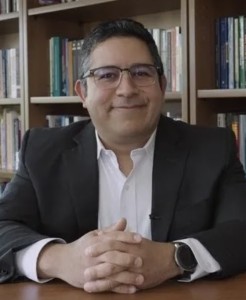
Ernesto Castañeda, American University
“Really, nobody is safe from deportation in this administration — particularly if they are from Latin America or Africa,” said Ernesto Castañeda, director of the Center for Latin American and Latino Studies and the Immigration Lab at American University. “Kids are disappearing from classrooms.”
And the pool of easily deportable immigrants might grow further still.
The Supreme Court just last month heard oral arguments over Temporary Protected Status, which grants hundreds of thousands of people from countries that are dangerously unstable the right to live and work here. That case involved Haitians and Syrians.
Venezuelans lost TPS protection last year and others might soon join them. The high court will render a decision in either late June or early July, and the outcome would impact people from several other countries, including Somalia and El Salvador.
“DACA is uncertain and TPS is basically gone,” said Deborah Chen, associate director for the Immigrant Protection Unit at the New York Legal Assistance Group.
Last June, U.S. Citizenship and Immigration Services announced that it was terminating the policy that provided deferred action for those with Special Immigrant Juvenile — or SIJ — status and removed their work authorization. Chen said SIJ and U Visas — granted temporarily for victims of certain crimes who have suffered mental or physical abuse and can potentially help prosecutors — once held tremendous power.
“They used to be like magic words in court,” she said.
Even the most desirable of all immigration statuses no longer leaves the holder immune from removal: The Trump administration recently targeted 12 naturalized citizens, alleging they concealed their support for terrorist groups or were guilty of war crimes, espionage or sexual abuse, according to the U.S. Department of Justice.

Multilingual volunteers with Citizenship Now! assist attendees in filling out paperwork in what’s billed as New York City’s biggest one-day naturalization event.
A 25-year-old green card holder at John Jay who declined to give her name for fear of deportation, said she’s been uneasy since January 2025.
“It feels like it doesn’t even matter if I have the proper documentation,” said the computer science major and Dominican native, who hopes to work in cybersecurity. “They’re going to find a reason — or create one — even if I don’t have anything on my record, just to kick me out.”
The Department of Homeland Security, which oversees the agencies that carry out immigration enforcement, refused to release the number of people it has arrested and detained in each immigration category. It did provide some information, which was not substantiated by outside sources, including that 2.2 million people have self-deported and 800,000 others were removed in Trump’s first year back in office.

Elora Mukherjee
“Our message to illegal aliens is clear: LEAVE NOW. If you don’t, we will find you, we will arrest you, and you will NEVER return,” a DHS spokesperson wrote to The 74.
Elora Mukherjee, the Jerome L. Greene Clinical Professor of Law at Columbia Law School, said many of the children and families she represents in court entered the United States lawfully through Biden-era humanitarian parole programs.
The Trump administration has declared these programs — they help Cubans, Haitians, Nicaraguans and Venezuelans — illegal, terminating recipients’ employment authorization and ordering them to leave the country.
“So all of those people who entered the United States lawfully and have been doing everything right — including the babies, toddlers and children whom I’m representing — are now at risk of arrest, detention and deportation,” Mukherjee said.
Her youngest client who falls in this category — and who got arrested — was 16 months old.
“It’s horrible,” she said.
‘The target is widening’
For more than a year now, young immigrants have been retreating from the nation’s K-12 schools and colleges, missing out on valuable time in the classroom while they watch their opportunities for advancement evaporate.
Some 75,000 undocumented students graduate from U.S. high schools each year, and there were 408,000 such young people enrolled in post-secondary education — college or trade schools — here in 2024.
Some campuses, in response to Trump’s ever-changing but aggressive immigration tactics, are hosting regular legal clinics inside their buildings to help worried students and their families. Previously, educators told The 74, providing a young person with the name of an immigration advocate or lawyer was considered sufficient.
Staff, too, have stepped up, sometimes by accompanying kids to immigration court when their parents can’t, fearful of their own deportation.
One woman who works for New York City public schools and who asked to remain anonymous to protect her students, made such a trip earlier this year. She watched as a teen boy’s mother — stopping within a few blocks of the courthouse so she would not be apprehended — said goodbye to her child.
“The mother was in tears,” the staffer told The 74. “She was hugging her son like she wasn’t going to see him again.”
The boy, from Ecuador, was reunited with his family after his court appearance. But not all young immigrants return home.
“I started teaching immigrant students in public schools in 1979,” said another New York City educator, who also asked not to be identified to shield her students. “And I would say it is the worst that I have ever seen, without question — and I’m talking about periods of massive factory raids in the ’70s.”
In 2023, some 14 million people inside the United States were undocumented. More than 40% enjoyed some form of protection from deportation.
There were nearly 38 million lawful immigrants — including almost 24 million naturalized citizens and just shy of 12 million legal permanent residents — in the country that year.
Immigrant advocates say Trump’s recent focus on naturalized citizens is a disturbing escalation of a long-standing goal. While his first administration took direct aim at some of these programs — it tried to end DACA, for example — its efforts were limited and often overturned by the courts.
Now, if it can’t annihilate such protections, immigrant advocates said, it can hobble them by narrowing their scope, firing non-compliant immigration court judges, piling on burdensome fees, limiting immigrants’ right to work and terrifying them to the point that they fear asking the court for help.
Chen, of the New York Legal Assistance Group, said she doesn’t see a quick turnaround, even if congressional control changes hands.
“One of the problems of the immigration courts is that it’s under the executive branch,” Chen said. “It is not an independent judiciary. With immigration, they’re able to control a lot of things just by internal memo and internal policy.”
A concerted plan to grow the undocumented population
America University’s Castañeda said he’s not surprised to see the administration go after immigrants for whom they already have identifying information, such as names and addresses. Even when that means targeting those who have served their country or are the spouses of military service members.
“Finding the undocumented — we’re talking about just 3% of the population — is actually hard and costly,” Castañeda said. “DACA is very easy because everybody has to, by definition, register.”
As the Trump administration shifts its deportation tactics, one of its primary enforcement agencies is getting a new leader. David Venturella, a career Immigration and Customs Enforcement official who also spent time working as a private prison executive, was appointed May 12 to take over ICE, which carried out the killing of Renee Good in Minneapolis earlier this year.
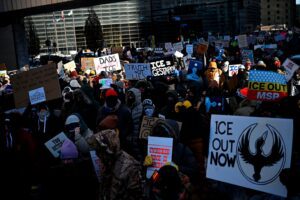
Demonstrators participate in a rally and march during an “ICE Out” day of protest on January 23, 2026 in Minneapolis, Minnesota.
A few weeks after Good was killed, Customs and Border Protection and border patrol agents sent to Minneapolis shot and killed Alex Pretti, setting off waves of national protests that forced the president to back down. He removed Kristi Noem as secretary of the Department of Homeland Security in March and replaced her with former Oklahoma senator Markwayne Mullin, who has said he wants to get DHS out of the headlines.

Wendy Cervantes (The Center for Law and Social Policy)
While leadership changes have been made and public-facing actions softened, there’s no reported evidence that Trump is giving up on his deportation campaign.
“Part of that mass deportation agenda is to basically dismantle the legal immigration system,” said Wendy Cervantes, director of the Immigration and Immigrant Families team at the Center for Law and Social Policy. “But we know that everything from the efforts to dismantle birthright citizenship, to strip away TPS, to weaken DACA protections, as well as make it harder to apply for lawful status … it’s all part of a concerted plan to grow the undocumented population.”
ICE is routinely deporting more than 30,000 people per month from detention centers, according to the American Immigration Council. This figure does not include people who self-deport or those permitted by an immigration judge to voluntarily leave the country.
“This is about who they want to define as an American and essentially saying that certain people here will never belong — and also that there are certain people here who we never want to see in power,” Cervantes said.
Monique A. Francis, interim executive director of CUNY Citizenship Now!, said her organization has helped more than 240,000 people with their immigration paperwork through the years.
She said Saturday’s event drew a smaller crowd than usual because immigrants are discouraged by the belief their paperwork will be delayed, and others were afraid the session was a trap and ICE would be there to apprehend them.
Some, she said, are waiting for a new president to be seated in order to complete the naturalization process. But she thinks that’s a mistake.
“If you have been dreaming of this for the last five years,” she said, “don’t delay the process because of the current administration.”