



Education Dept’s Overhaul of Grant Rules Sparks Concern About ‘Instability’
But with control of the next Congress, Democrats could ensure officials don’t hold up funding to schools.
The 74 | By: Linda Jacobson | November 9, 2026
Last December, the Department of Education abruptly cut nearly $170 million in funding for community schools across 12 states because, officials said, the program was no longer in “the best interest of the federal government.”
Within days, thousands of students lost afterschool programs, tutoring, job training and other services as schools let go of hundreds of staff or canceled contracts with outside providers.
“We have never been able to recover from that level of instability,” said Susan Stanton, executive director of Afterschool for Children and Teens Now Coalition, an Illinois nonprofit that was administering two grants serving 19,000 students across 32 schools. The organization is still fighting in federal court to recoup all of the $70 million it expected to receive over three years. “If overnight, teachers are getting fired and we’re cutting services, how do you make that make sense to a child?”
Nearly a year later, she’s among those who worry such cancellations could become routine as the Education Department overhauls how it distributes and manages grants. The administration wants more control over spending, as it has shown by rescinding funds Congress appropriated and redirecting grants toward charter schools. But Democrats and those depending on federal dollars argue the rules are arbitrary and will create more disruption for students.
One former Biden administration official said the multiple changes demonstrate that Education Secretary Linda McMahon’s team at the department “have an expansive view of their power.”
“[They] are doing everything they can to advance their agenda,” said Maureen Tracey-Mooney, who led K-12 policy development for the White House Domestic Policy Council and is now the associate director of FutureEd, a Georgetown University think tank.
But Democrats, who captured both chambers of Congress during Tuesday’s midterm elections, could make it a priority to ensure that officials don’t hold up funding.
“I think we can expect dramatically more oversight from Congress on these issues,” she said. Future appropriations bills or committee reports would likely include “much more explicit direction around how funds should be spent.”
‘Less than the length of an X post’
One new requirement, which took effect Nov. 1, isn’t unique to the Education Department. It’s a government-wide rule that federal grantees, including school districts, nonprofits and colleges, submit written justifications every time they make a payment request. The mandate stems from President Donald Trump’s executive order last year that agencies create systems that allow leaders to “pause and rapidly review” payments.
“In certain circumstances, it may be necessary to reject a recipient’s justification for payment request outright,” Murray Bessette, the department’s acting assistant secretary for the Office of Planning, Evaluation and Policy Development, wrote in a Sept. 28 memo.
A how-to guide linked in the memo says grantees would need to justify, in no more than 255 characters, withdrawals as small as $75 out of grant awards totalling hundred of thousands of dollars. The new rule, which has been gradually phased in at other agencies, applies not only to competitive grants the department cancelled because officials said they focused too much on diversity, equity and inclusion goals or gender identity. It also extends to major programs, like Title I for high-poverty schools and special education funding.
Last year, the department delayed telling states how much they would receive in Title I funds for 2025-26, notifications that states and districts depend on to plan staffing and programs for the school year. This year, the process ran smoothly and states received their funds on time.
But education advocates say the added documentation for what could be hundreds of thousands of transactions each month creates more red tape for states and districts at a time when the department says it’s trying to free states from unnecessary compliance burdens. When Education Secretary Linda McMahon awarded South Dakota one of the department’s “returning education to the states” waivers, she said she didn’t want to force “state leaders to jump through separate, bureaucratic hoops to use federal funds.”
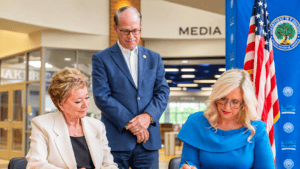
Education Secretary Linda McMahon, left, joined Indiana Secretary of Education Katie Jenner and Gov. Mike Braun to grant the state a waiver from some federal funding requirements.
Jaeya Jones, a spokeswoman for the South Dakota Department of Education, said the agency “does not anticipate a significant burden or significant additional staff time” to comply with the requirement. Shanderia Minor, with the Mississippi Department of Education, said the staff is “preparing for implementation,” and will make adjustments if the requirement takes more time and resources. Lindsey Hedges, with the Vermont Agency of Education, said officials intend to track how much the requirement adds to their current workload.
With the staff at the department roughly half of what it was when McMahon started, some observers also wonder if there are enough employees to read all of those explanations.
“Payment delays are likely if and when requests accumulate faster than remaining staff can process them,” said Ariel Taylor-Smith, senior director of policy and action at the National Parents Union. “And when payments stall, districts must front the cost of special education services and Title I reading interventions or delay them.”
Savannah Newhouse, a spokeswoman for the department, suggested that when it comes to federal dollars, there’s no such thing as too much oversight.
“Are you comfortable with $75 of your taxpayer dollars going to fraudulent or non-allowable purchases?” she asked. “What an absurd premise. We’re not asking grantees to write an essay; we’re asking them to justify their spending in a 255-character text box — less than the length of an X post.”
She pointed to The 74’s reporting on eyebrow-raising purchases some districts made with pandemic relief funds, like $86,000 for accommodations at Caesar’s Palace in Las Vegas for staff from a Utah school district attending a conference and a fast-tracked $7 million payment for air purifiers in Stockton, California, from a company linked to a former mayor who had a string of past arrests.
But there were few strings attached to COVID relief funds. Districts received an unprecedented $190 billion in a short span of a year and had a short timeline to spend it.
When it comes to annual funding and the department’s array of grant programs, education finance experts and past grantees say there are already safeguards in place to ensure recipients use funds as intended.
The department “had eyes on us through reporting every six months,” said Stanton, with ACT Now in Illinois.
The government also requires districts spending over $1 million in federal funds to be audited every year and has a system for identifying and reducing improper payments. Rick Hess, a senior fellow at the conservative American Enterprise Institute, called the backlash to the new rule “an odd dance.”
“The folks who’ve promised to reduce red tape are imposing the changes that are raising the concerns,” he said, “and the people who are raising concerns about red tape are the people who’ve long been dismissive of such complaints.”
‘Vague conditions’
The second change underway is very similar to a White House Office of Management and Budget proposal that would allow the department to cancel grants midstream “for convenience” so that projects “remain aligned with department priorities.”
Congress blocked OMB from finalizing their version, but the Education Department is moving ahead. The proposal removes language that asks how applicants would address the needs of historically underserved students, and would no longer require the department to publish grant opportunities in the Federal Register. Notices would only appear on Grants.gov.
Over 5,500 groups and individuals submitted public comments on the Education Department’s proposal before the Sept. 23 deadline. Defending Education, a close ally of the Trump administration, said the rule is easy to follow and “clarifies much of the authority the department already possesses.”
But the vast majority argued that the rule attempts to take power away from Congress and overly politicizes the grant process. Many expressed concern that it would leave schools and kids on shaky ground, with districts unclear whether to hire staff they might not be able to pay if officials pull their funding.
Twenty-three attorneys general said that if implemented, the new requirements would “severely harm” their residents and place “vague conditions with no basis in law.”
The Coalition of Mothers, led by Florida parental rights advocate Rebekah Ricks, is especially concerned about losing advance notice of initiatives in schools if new grant competitions aren’t published in the Federal Register.
“Without it, parents learn about a federally funded program after it reaches their children,” Ricks said in a letter.
If the department finalizes the rule, the new majority in Congress could disapprove it, but experts say it’s more likely that they would use language in appropriations bills to prevent the administration from disrupting funding.
Larger awards for fewer grantees
Another proposed provision would allow officials to “frontload” grants — award the entire amount at once instead of stretching it out over multiple years. It’s a practice the department is already using, one that members of Congress say has “dramatically” decreased the number of grantees receiving funds.
In a letter to the secretary, Democratic Sens. Patty Murray of Washington and Tammy Baldwin of Wisconsin noted how the department said earlier this year that it would make 25-35 awards through its Innovative Approaches to Literacy grant. But it made only four.
“It is inexplicable that a department claiming literacy as its top priority would so drastically limit the number of new grants supporting evidence-based literacy programming,” the senators wrote.
Education Department officials have also frontloaded grants for research, teacher preparation and child care for children whose parents attend college, even though they told Congress in July that they had received almost twice the number of applications since the last round of awards.
In a statement, Ellen Keast, a department spokeswoman, said the agency’s strategy has nothing to do with having fewer staff on hand to manage the grants.
“The better question is why would an administration dedicated to improving literacy outcomes and supporting child care for low-income student parents continue the failed approach of previous administrations?” she said. “Yes, we are returning education to the states and have furthered that effort by funding the highest-quality grantees that will help kids learn to read and support parents in college.”
But one past grantee in Kentucky worries that the approach will disadvantage rural communities who stood a better chance of winning a grant when there were more awards.
The Innovative Approaches to Literacy program, which supports efforts to improve low-income students’ reading skills, “has historically provided a pathway for small rural school districts and rural-serving organizations to secure meaningful direct federal investment,” said Dreama Gentry, founder and CEO of Partners for Rural Impact, which received one of those grants in 2023. “If federal grantmaking increasingly moves toward fewer, larger, multiyear awards, we should be asking who gains greater certainty — and who loses access altogether.”