

Florida pushed back on AP classes. Its first alternative option? Algebra
Tampa Bay Times | Jeffrey S. Solochek | September 18, 2025
The new courses are part of the state’s push to offer options other than Advanced Placement.
Two years ago, Gov. Ron DeSantis laid out his problems with Advanced Placement courses.
First, he refused to approve use of a fledgling AP African American studies course in Florida high schools, claiming it “lacked educational value.” Later, his administration targeted concerns with AP psychology and its lessons on gender identity and sexual orientation.
DeSantis argued Florida could do without AP — an unpopular stance among teens and families who rely on the program for college credits — and create its own accelerated alternatives.
Lawmakers set aside nearly $5 million toward that goal. Since then, the state has spent less than $150,000 of that allocation, and discussion about Florida-created replacement courses all but disappeared.
This fall, though, the state rolled out its first course under the umbrella of the 2023 legislation. And the subject had nothing to do with the topics that had caused so much consternation.
Instead, the state took on algebra.
The course, Florida Advanced Course and Test (FACT) College Algebra, debuted this fall in more than 30 schools throughout the state, including four in Pasco County and one in Pinellas County, with full implementation planned statewide next year.
It’s nothing like an Advanced Placement course, local teachers said.
“This is a gateway course,” said Stephanie Van Tassel, math curriculum specialist for Pasco schools. “It wouldn’t be competing with any of our AP courses.”
College Board, the company that creates and publishes AP courses, provides four AP math classes — precalculus, calculus, advanced calculus and statistics.
FACT Algebra is aligned with the entry-level general requirement math class many students take at Florida colleges and universities. Instead of being offered to teens as a one-semester dual enrollment course, which already was an option, it’s now available as a yearlong version taught by high school teachers.
“It does slot into that in-between space,” said Robert Schoen, associate professor of math education at Florida State University. “It’s kind of high school material but it’s college credit. So it’s college prep in that sense. … It’s not a course that the engineering program would consider a math course.”
When asked, state officials did not explain why they started the rollout of Florida-created acceleration courses with algebra rather than African American studies or psychology.
The algebra course is important, Florida Department of Education spokesperson Nathalia Medina said via email, because it’s a gateway for many majors and careers. Making it more widely accessible “increases options for for students to earn college credit and be better prepared to enter postsecondary.”
The state did issue contracts totaling $127,843 to Miami Dade College and the University of Central Florida in 2024 to work jointly on a psychology course through the Florida Partnership for the Development of Advanced Courses, which is to be funded by the legislative appropriations. Records show the work should have been completed by early 2025. That course has yet to surface.
For comparison, College Board says it develops its new courses over several years, seeking the input of a “wide range of experts.” Members of the committees that create the courses get paid a small honorarium plus expenses. Its method also includes public review, including feedback from students, teachers and officials, such as when DeSantis weighed in on the African American studies course.
Department of Education officials did not say who developed the algebra course, stating only that it was created in collaboration with high school and college faculty members. They also did not say how much money was spent on the development, except to say it fell under the legislative directive to establish more advanced courses.
No contracts were listed for it on the state’s accountability tracking system.
James Cady, who is teaching FACT Algebra at Pinellas County’s Northeast High, said trainers told teachers it replicates a 15-week course from Tallahassee College, but provides a 36-week syllabus.
“It’s actually extremely similar to Algebra 2 Honors. It’s a lot of the same material,” Cady said. “It just goes a lot deeper.”
That makes the course a welcome addition to the high school curriculum for students who want to learn the material but are not necessarily ready for the pace of college, he said. Students who do not earn a set score on the Postsecondary Education Readiness Test are not eligible to take dual enrollment classes, he added.
“I actually get time to work with kids one on one,” Cady said, anticipating student interest will grow over time.
Diving into the numbers
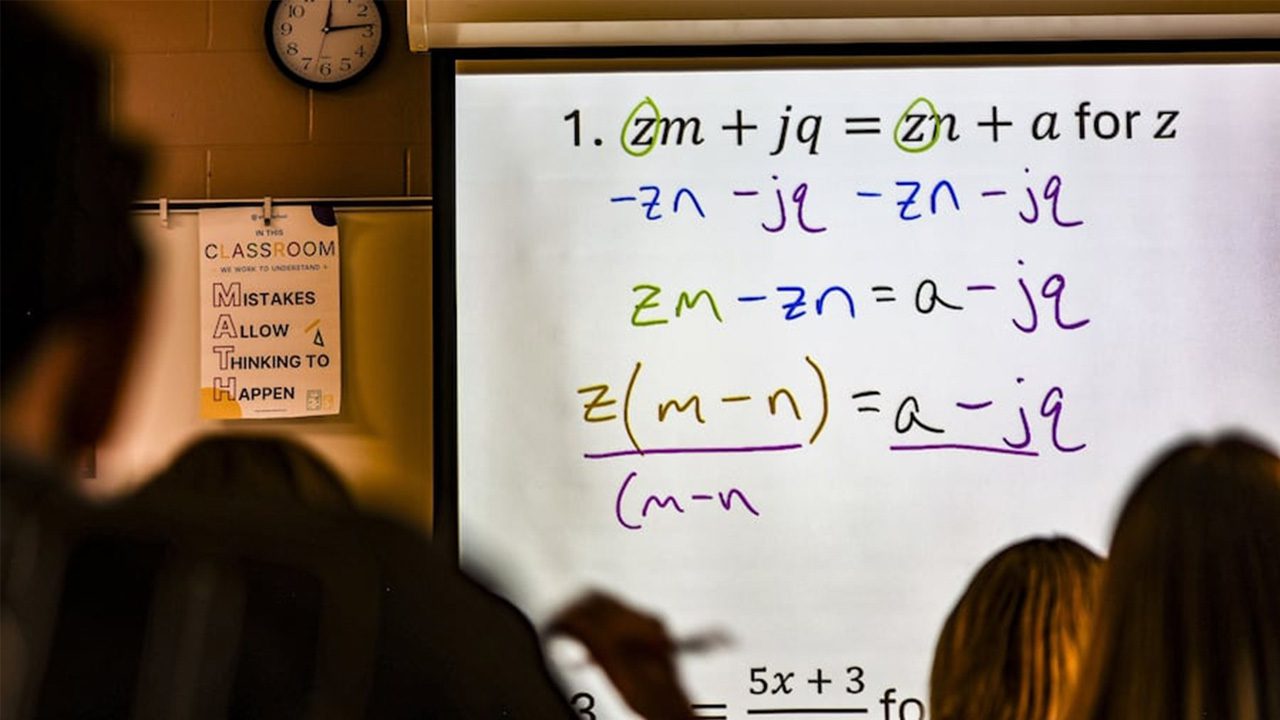
On a recent afternoon, teens taking FACT Algebra at Pasco’s Mitchell High School worked on solving equations such as zm + jq = zn + a for a single variable, in this case z. Teacher James Dye walked them through the first example, asking what steps they would take including factoring — “my favorite f word,” Dye said to groans and grins.
When he saw one student erasing a mistake on her paper, he quickly told her to stop. Never erase, he said to the entire class, explaining it’s better to see and learn from errors than to make them disappear.
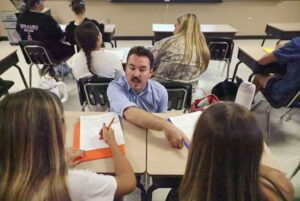
Math teacher James Dye, center, helps College Algebra students Kelby Almendarez, 17, left, and Bella Packer, 17, right, through a literal equation on Tuesday, Sept. 9, 2025, at Mitchell High School in Trinity.
As the class worked through more equations, Dye circulated to answer questions. The students, mostly juniors and seniors who had taken two years of algebra already, said they welcomed the new course when they got the chance to take it.
Some, like junior Ella Parmenter, said they liked the idea of earning college credits without having to sit through a harder AP course and test.
“It’s very slow paced and easy to keep up,” said junior Myla White, whose packed schedule also included AP literature and psychology. “This is very doable.”
Senior Ethan Livingston said he switched to this class from probability and statistics, which didn’t offer college credits.
“That’s what I’m looking for,” said Livingston, who plans to study nursing at the University of South Florida. “I get college algebra … (and) I don’t have to do it in college.”
Dye said that while it’s not an AP course, FACT Algebra fits a niche for students who plan to attend a Florida college or university, can’t or don’t want to take dual enrollment, and might not have a lot of math in their future.
“I do see a need for this course in our district,” said Van Tassel, the math specialist. “I’m excited for the opportunity.”