

Florida Study: Cellphone Bans Promote Academic Gains … After a Year or So
The 74 | By Greg Toppo |
Student performance on reading and math tests improved modestly — but suspension rates also rose after state banned cellphones for all students.
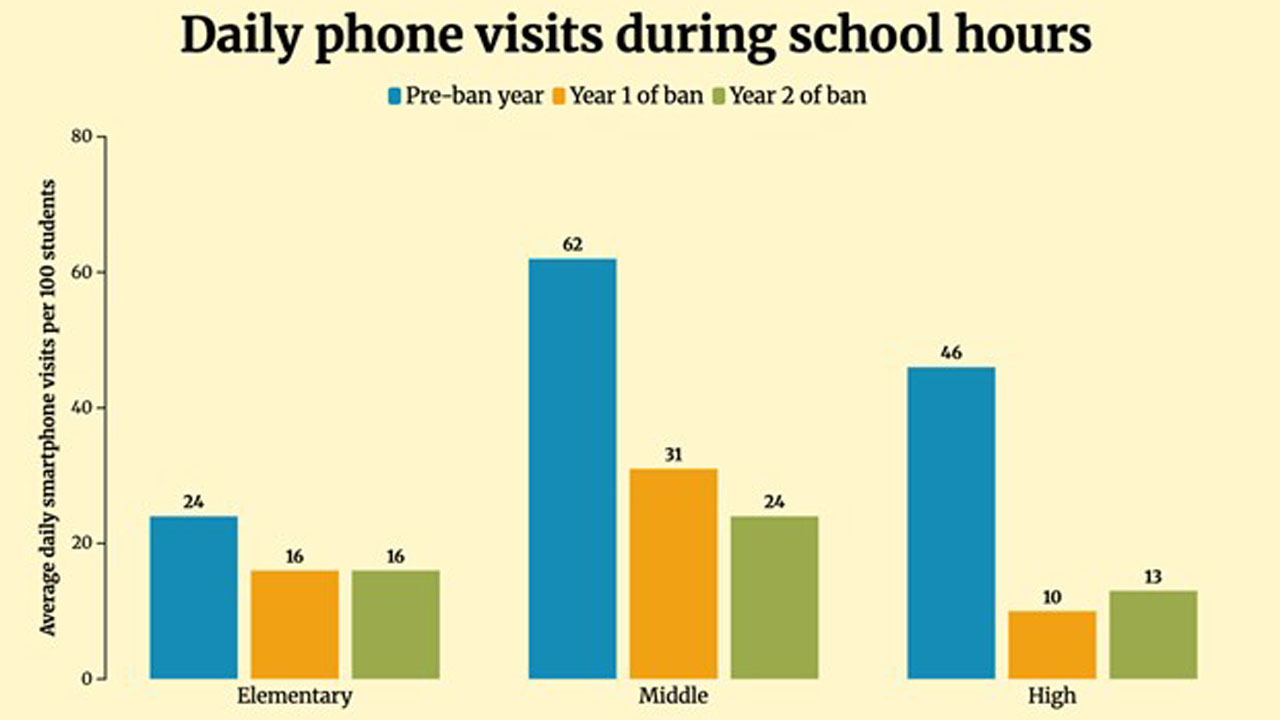
The first study probing what happens when an entire state bans cellphones in schools finds that they do what they advertise: Phone use goes down precipitously, with daily cellphone visits falling by more than 80%.
More significantly, after Florida’s 2023 ban went into effect, student performance on reading and math tests improved modestly, at least in one large district studied, with scores up by about 3.5 percentage points in its second year. Schools with the highest pre-ban cellphone use saw the largest positive impacts.
But a pair of researchers studying the state’s first-in-the-nation statewide cellphone ban also tracked a 25% spike in suspension rates in the first year, with the biggest impacts on Black students. At schools with high levels of pre-ban cellphone use, the rate of in-school suspensions for Black students rose by 30%, while rates for white and Hispanic students remained steady.
In the second year of the ban, disciplinary rates returned to pre-ban levels. Those findings are similar to those of a national study on cellphone bans published last week.
Researchers David Figlio and Umut Özek also found “significant reductions” in the number of unexcused absences in both the first and second years after the ban, especially among middle and high school students. That drop in absences could also help explain, in part, the better test scores, they said.
The Florida ban, adopted in May 2023, made cellphones off-limits to students during instructional time, but allowed local districts to impose additional restrictions according to their needs.
Figlio, an economist at the University of Rochester, noted that Florida is an unusual place to study the topic, since it was one of the first states “to really get back to normal in schooling” after the shock of the COVID pandemic and widespread school closures.
“Schooling was business as usual in the 2020-2021 academic year in Florida,” he said in an interview. “It was not business-as-usual in almost any other part of the country.” That could have delayed potential academic improvements around cellphone bans in other states, he theorized.

David Figlio
Figlio said the discipline data is concerning, since phone-related suspensions were, at least at first, “disproportionately borne by male students and especially by Black students.”
While it’s possible that Black students were simply violating the rules more often, it’s also possible that the rules “were being more heavily enforced” for these students. “Whenever I see any evidence of disproportionality in terms of any policy, that’s always a cause for concern for me. And so that’s what I’ll call the dark lining in what I think is a silver cloud.”
When Figlio and Özek’s findings appeared last fall as a working paper in the journal of the National Bureau of Economic Research, they were the first to look at a universal school cellphone ban policy. A newer paper, also published by the bureau, studied nationwide data on cellphone bans compiled by Yondr, a California startup that makes lockable pouches for schools, businesses and entertainment venues.
That paper, released May 4 by a team led by the Stanford researcher Hunt Allcott and Duke University’s E. Jason Baron, found that school cellphone bans don’t typically bring improved academic achievement or better behavior, as many advocates have hoped.
Figlio suggested that the broader look at cellphone restrictions could have been subject to a kind of “post-COVID transition period” that showed slower academic improvement.
In their study, Allcott, Baron and colleagues called the Yondr restrictions “particularly stringent and physically binding,” suggesting that they provide a way to measure cellphone restrictions more accurately than “no-see” policies that simply ask students to keep phones powered off and hidden. They also said the national scope of their study “provides substantial statistical power” to examine the policy across different schools.
In an interview, Stanford economist Thomas Dee, one of the researchers working with Alcott and Baron, said no-see policies are inconsistently and unevenly enforced. “We wanted to leverage the data from Yondr because it gives us much more confidence that in-school use of phones is actually being restricted,” he said.
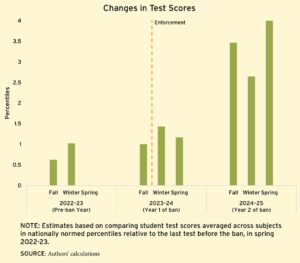
The new paper by Figlio and Özek, appearing Tuesday in the journal Education Next, updates data on cellphone restrictions nationwide to include policies newly in effect this spring.
It looks at an unnamed Florida district which is one of the nation’s largest — the list of the 10 largest U.S. district includes five in Florida — where local leaders imposed a “bell-to-bell” ban that prohibits using phones, earbuds and smartwatches throughout the entire school day, including noninstructional time.
The new rules went into effect at the start of the 2023–24 school year. After Labor Day, if a student violated the rules, their device was confiscated and returned at the end of the day, with the option for suspension.
The district carried out the state ban as a “no-see” or “off-and-away” policy, Figlio said, so the expectation was that students had their phones off and out of sight. A few schools used the lockable pouches, he said — schools in all five of the state’s biggest districts had Yondr accounts — but pouches were “not the dominant form of enforcement.”
Figlio sees the two studies as complementary, comprising “two different ways you can really study this topic credibly,” especially as some places implement “no-see” policies and others rely on pouches. He noted that both studies, in effect, find “zero-to-small positive test score improvements” initially, but more positive results after that.
A 2024 Pew Research study found that about one in three teachers consider students distracted by cellphones “a major problem.” Among high school teachers, that figure rises sharply, to 72%. More recently, Pew researchers in July 2025 found that 74% of U.S. adults say they would support banning cellphones during class for middle and high school students, up from 68% late 2024.
Figlio said a future version of the Florida study will also track evidence that student reports of classroom climate, school climate and teacher-student interactions improve under cellphone bans. After a short negative period, students also report improved well-being.
“Whenever we introduce new policies and they really take off like wildfire, I think a lot of people are hoping that they’re going to find that this is ‘The Solution,’” Figlio said.
In the end, what both studies find is that cellphone bans “are not a panacea,” he said.
“The biggest thing that these cellphone bans did was dramatically reduce student use of cellphones in the school,” Figlio said. “For people who think that’s a good thing for any number of reasons, that’s a good thing — that’s a sign that cellphone bans worked. For people who were expecting this to lead to a major turnaround in the ‘achievement recession,’ where achievement had been dipping even before COVID and continued to dip following COVID, I think they’re going to be disappointed.”