


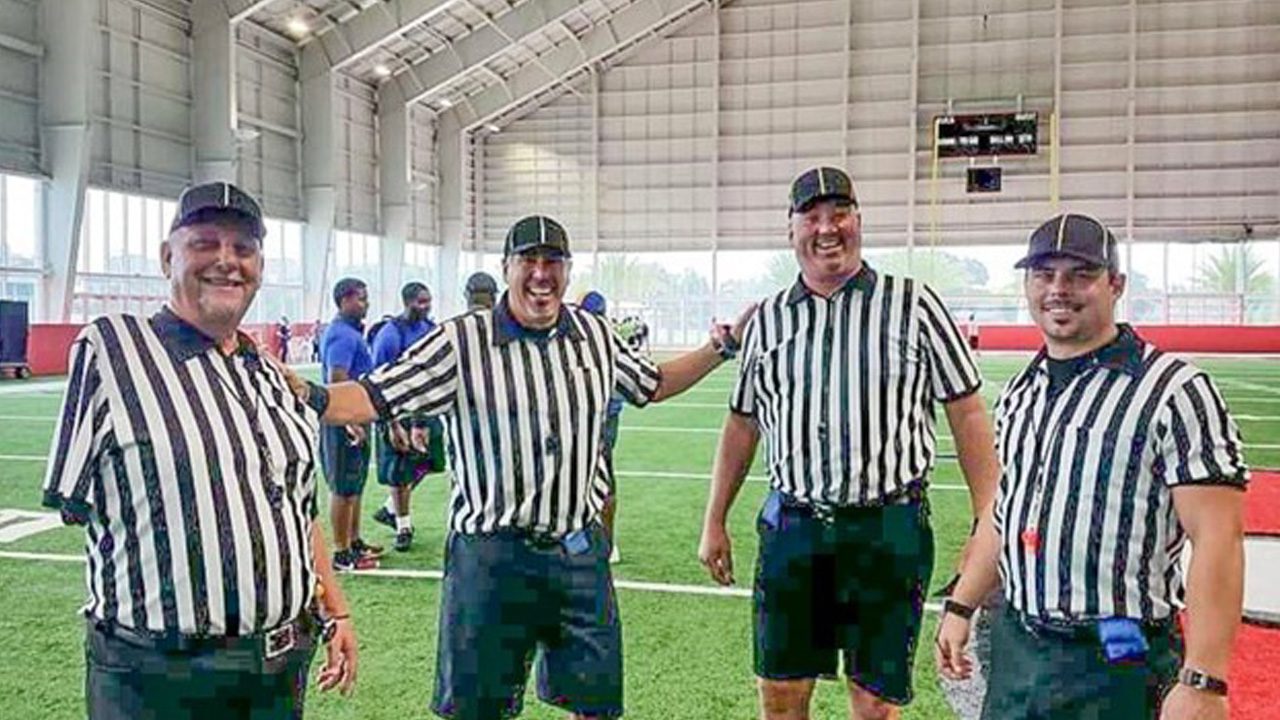
Gray hair, black stripes: How Pinellas retirees are saving Friday night football
Tampa Bay Times | By Bob Putnam |
As thousands of high school officials quit nationwide, veteran retirees are playing an increasingly crucial role.
On game nights, Wallace DeVries stays hydrated to combat Florida’s heat. He eats light. He studies his rule book.
It’s the same routine the 70-year-old, one-armed official has performed for a half-century. DeVries is one of eight retirees helping keep high school football alive in Pasco, Pinellas and Manatee counties through the Suncoast Football Officials Association.
Nationwide, roughly 50,000 high school officials have quit since the 2018-19 season, according to the National Federation of State High School Associations. The shortage has forced Pinellas County to schedule some varsity games on Thursday nights in recent years, a break with Friday tradition.
The Suncoast association’s average official age of 53 reflects a broader trend: Veteran retirees are playing an increasingly crucial role.
“Once these retirees can no longer work the field, most will transition to the clock,” said Michael Ryckman, the association’s treasurer. “They remain involved by conducting evaluations, teaching training classes or serving on our board.”
The retirees, like other officials, arrive 90 minutes before kickoff. They meet in locker rooms for pregame conferences, review rules and check equipment. Their compensation is $125 for varsity games this year, up from $111 last season.
The statistics paint a clear picture. The average age of surveyed officials rose to 56.7 in 2023 from 53.3 in 2017, according to the National Association of Sports Officials. More than 70% of new referees quit within three years, primarily due to abuse from parents and coaches. Traditional recruiting methods are no longer effective; requests for help are falling on deaf ears.
“We’re having to get creative,” Ryckman said.
This past offseason, the association reached out to all member schools, asking football staffs to recruit graduating high school seniors. The pitch: Officiating allows for continued involvement in the sport while earning extra income and potentially advancing to college levels.
Two officials from the association advanced to college officiating recently.
The challenges of attracting and retaining officials make the dedication of veterans like DeVries all the more remarkable.
For instance, DeVries is no stranger to overcoming obstacles. He lost his right arm in a 1972 work accident. A Michigan basketball official told him, “You don’t have to miss sports — you can officiate them.”
He drove to Lansing to take certification tests for baseball, basketball and football. That journey brought him to Florida and eventually to working the 2025 FHSAA 7A championship game as a side judge.
Stu Epley, 76, offers a different story. After 48 years on the field, health issues moved him to the clock in 1999. He still works every Friday night, rushing from his day job to arrive an hour before kickoff.
“I could not wait to leave work on Fridays and drive directly to my game, sometimes dressing in my car,” Epley said.
His crew worked the 1987 state championship at Naples Lely. He still has the 8-track tape recording he listened to on his drive to the game.
Both men demonstrate what younger officials often lack: unwavering commitment.
Epley criticizes newer officials who “block several dates in the football season” and aren’t “all-in.” DeVries helps train newcomers alongside fellow veteran Jayme Ream.
Don Noble, 76, moved from Buffalo for work and initially planned to quit officiating. But after teaching a class at his former association, “the desire to continue was there.”
He contacted the Suncoast group and resumed his career.
Noble’s background as an aerospace operations director helps him handle difficult situations. During a state semifinal, he defused tension when one team stared down opponents during introductions.
The compensation reflects ongoing challenges. Florida’s $125 for varsity games trails neighboring Georgia, where officials earn $128.
These retirees find rewards beyond money. DeVries treasures moments when former players approach him years later, sometimes bringing their fathers who also played in games he officiated. Epley received “Official of the Year” from the Suncoast Football Coaches Association in 2018.
Their approach to conflict differs markedly from younger officials’ experiences. When angry coaches confronted Epley, he lowered his voice and said he’d be happy to talk “only in a calm manner.”
It worked most of the time. Noble has endured three decades of criticism.
“Really aggressive behavior in what they say about us, or something funny like, ‘Hey ref, don’t trip over your seeing-eye dog,’” he said.
His rule: Coaches can disagree with calls, but personal attacks cross the line.
Parents spend more time and money on children’s sports, creating professional-level expectations for high-school level officials, according to Jerry Reynolds, a Ball State University professor of social work.
DeVries sees his role as more than rule enforcement. “The call that you make can affect players, coaches, officials and fans for the rest of their lives, whether positive or negative,” he said.
When these eight retirees step away, the Suncoast Football Officials Association faces serious challenges. Thursday night games already represent a compromise with tradition, but the association’s creative recruiting efforts and the retirees’ continued involvement in training offer some hope.
Epley believes it would be “tough for a retiree to start the process at retirement age” due to rules, tests and the physical demands of August heat. Still, he encourages healthy retirees to try.
The situation presents an irony: These men began officiating during their careers, developing expertise over decades.
Now they’re asked to shoulder a burden younger generations reject.
As DeVries prepares for another game, he embodies a question facing high school athletics nationwide: What happens when the last generation willing to endure the abuse and poor pay finally walks away?
The answer may determine the future of Friday night football.