

New Data Shows More Districts Are Adopting AI but Still Need a Coherent Strategy
The 74 | By Bree Dusseault & Jared Hurwitz |
Dusseault & Hurwitz: With students still facing pandemic learning loss, schools must focus on systemic transformation, not isolated innovation.
The Center on Reinventing Public Education has been tracking the evolution of how districts and schools approach generative artificial intelligence since 2023. Today, CRPE is releasing an updated database for the 2025-26 school year.
Since last year, more districts have been publicly sharing information about their AI strategies, and these are increasingly sophisticated and varied. While only a few are using AI to fully rethink instruction or tackle longstanding challenges, the total number of districts in our database of early adopters has nearly doubled in a year, from 40 to 79, with the most growth happening in urban areas. Below are initial findings from the 2025-26 early adopter cohort.
More early adopters, including more urban districts, are piloting systemwide AI strategies
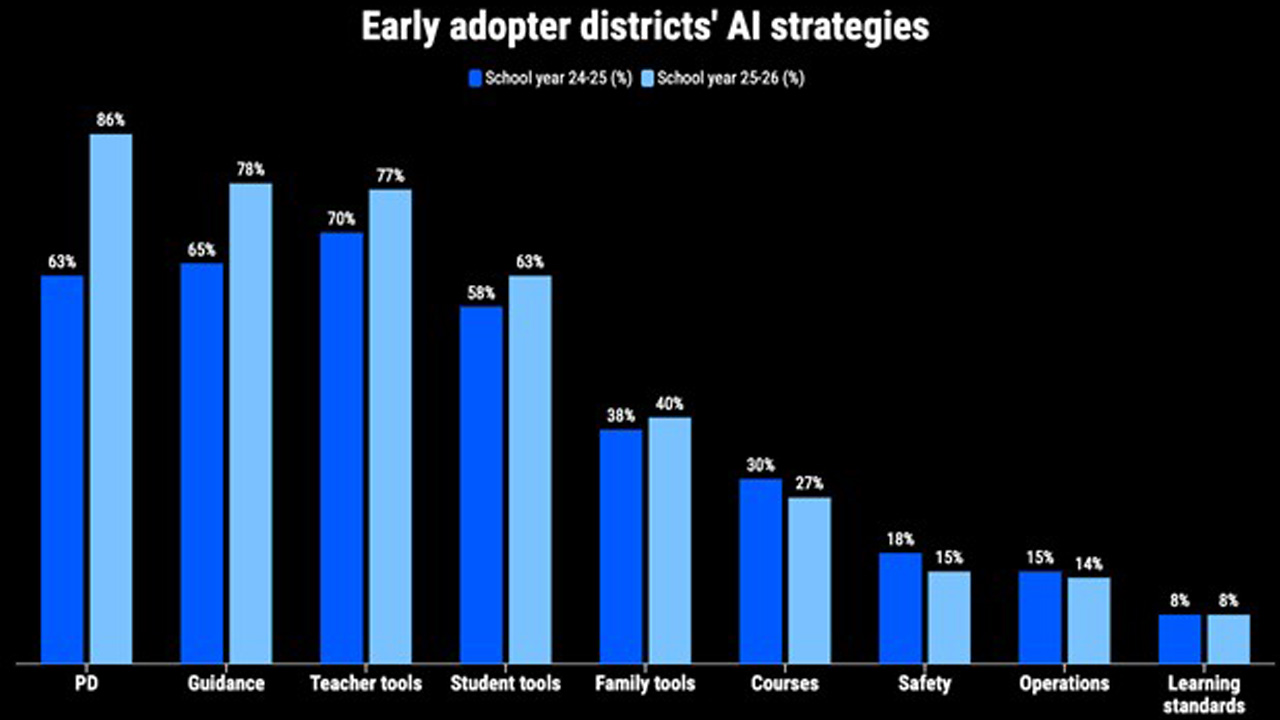
The number of districts offering teacher professional development is up to 86% this year from 63% last year. More districts are providing guidance about AI use (78% this year versus 65% last year), and more are giving AI-powered apps and tools to educators (77% this year versus 70% last year) and to students (63% versus 58%).
Several large, urban districts are shifting from isolated, piecemeal implementation to more transparent, complex and strategic approaches that go beyond tool testing or teacher literacy.
For example, Denver Public Schools recently published a Handbook on AI in Schools that includes a continuous-learning framework and guidance. The district’s vision moves beyond simply providing instructions on using popular apps to highlighting AI’s potential to improve data-driven decision-making, real-time coaching and personalized learning. It also outlines ways AI can aid students with disabilities and multilingual learners. The district surveyed students and staffers about AI preferences and usage to develop its handbook.
Charlotte-Meckenberg Schools in North Carolina, which released its AI Vision and 2025-26 Generative AI Guidance in spring 2025, takes a different approach. The district will provide training on and access only to specific, targeted AI tools it approves and continue a districtwide ban on others, including ChatGPT. It has designated 30 “AI Champion Schools” to explore the technology and share what they have learned.
Early adopters are also focusing more on students
As AI literacy efforts for teachers increase, more districts (63%) are also prioritizing student-centered resources and tools.
Several are using tools created by, or customized for, their students. For example, at Bullitt County Public Schools in Kentucky, students developed an AI assistant-powered platform in their Java Programming I course to answer questions on topics ranging from homework to current events. The skills students strengthened while working on this project, like collaboration and problem solving, are among those outlined in the district’s Graduate Profile. Students also helped design a districtwide anti-bullying counseling tool.
While more districts are bringing AI to students, only a few are sharing information about shifts in learning standards, which helps build community buy-in and trust. Iowa City School District is an exception, announcing it would implement a new curriculum on how to use artificial intelligence, with age-appropriate lessons required by the school board. The district also said it would offer electives on AI for seventh and eighth graders.
A very small number of districts are systematically engaging students in building AI strategy. One example is Mountain View School District in California, which asked high schoolers to help shape policies. Selected teens serve as tech interns who facilitate dialogue among students, teachers and school leaders about AI and developed a chatbot that contributes to draft artificial intelligence policies for the district.
Reimaginers continue to push the edge of what’s possible
Last year, we identified a small cohort of reimaginers, districts that include AI strategies in broader plans for change. Even a year later, only a few districts qualify as reimaginers, but their progress is promising. They are diving deeper in 2025-26, piloting AI to transform schools or student learning.
In fall 2025, ASU Prep opened a hybrid high school in collaboration with the Levitt Lab. It uses a mastery-focused, project-based learning model that blends personalized learning with seminars modeled on the Socratic method, where teachers engage students in dialogue and encourage them to develop and defend a point of view.
Bullitt County Public Schools is piloting a suite of custom-made, AI-enabled coaching tools to help teachers and school staff transition to competency-based learning. Developed in partnership with Incubate Learning and built with Playlab.ai, some provide 1:1 coaching for teachers, instructional coaches, school leaders and central office teams. Others help educators and leaders design learning experiences and reflect on whether their instructional practices and other initiatives are helping students.
Districts must advance coherent AI strategies for teaching and learning
While it’s encouraging to see more districts embracing AI, adoption remains fragmented, and district leaders and teachers are still overwhelmed. Early adopters must keep their focus on systemic transformation, not isolated innovation.
Strategies to do this include:
- running more short pilots, analyzing the results immediately and adopting what works, to keep up with emerging tools and technology shifts;
- testing ways to use AI to streamline administrative or operational tasks;
- aligning AI solutions to a broader vision of teaching and learning;
- committing to helping district leaders, educators and students understand the risks and potential benefits of using AI;
- including students in designing strategy and solutions.
The emerging data on early adopters signals that more districts and schools are willing to embrace AI’s potential to transform education. At the same time, students have yet to recover from pandemic learning losses, reminding education leaders what is at stake. Without a coherent vision or systemic strategy for learning, districts risk adopting AI in fragmented ways that widen student achievement gaps and yield short-term gains rather than genuine transformation.