

‘Parasites’: Miami-Dade school board hopefuls slam ‘Schools of Hope’ law
Miami Herald | By: Austin Horn | July 16, 2026
The eight candidates vying for the District 1 seat on the Miami-Dade school board offered a broad range of ideas on how to improve the school district at a forum Wednesday night, but on one issue, they all aligned — sharp criticism of Florida’s “Schools of Hope” law. The law requires districts to make underused and ”persistently low-performing” schools available to be occupied by approved charter operators, often at a low cost. Five such schools, including two in the predominantly Black North Dade district, from charter operator Success Academy will open in 2027.
None of the candidates supported the law, with nearly all speaking clearly against it. One even compared the schools to “parasites.” “I think we all know what a parasite is. A parasite benefits itself at the expense of the host. So, if we continue to go this route, we’re going to destroy public education as we know it,” Erhabor Ighodaro, former vice mayor of Miami Gardens and top staffer to late school board member Robert B. Ingram, said. Ighodaro suggested increasing magnet programs within public schools as a way to fend off the “Schools of Hope” operators. Other candidates offered up different solutions. Katrina Wilson, a former principal who resigned from her spot on the city council of Miami Gardens to run for the school board seat, said schools should focus on high-quality education and services to “remove the need for colocation.” Bernard W.H. Jennings, a former Miami-Dade Democratic Party official who now serves as chair of the board of trustees at Florida Memorial University, suggested another student population count to more accurately capture student body size.
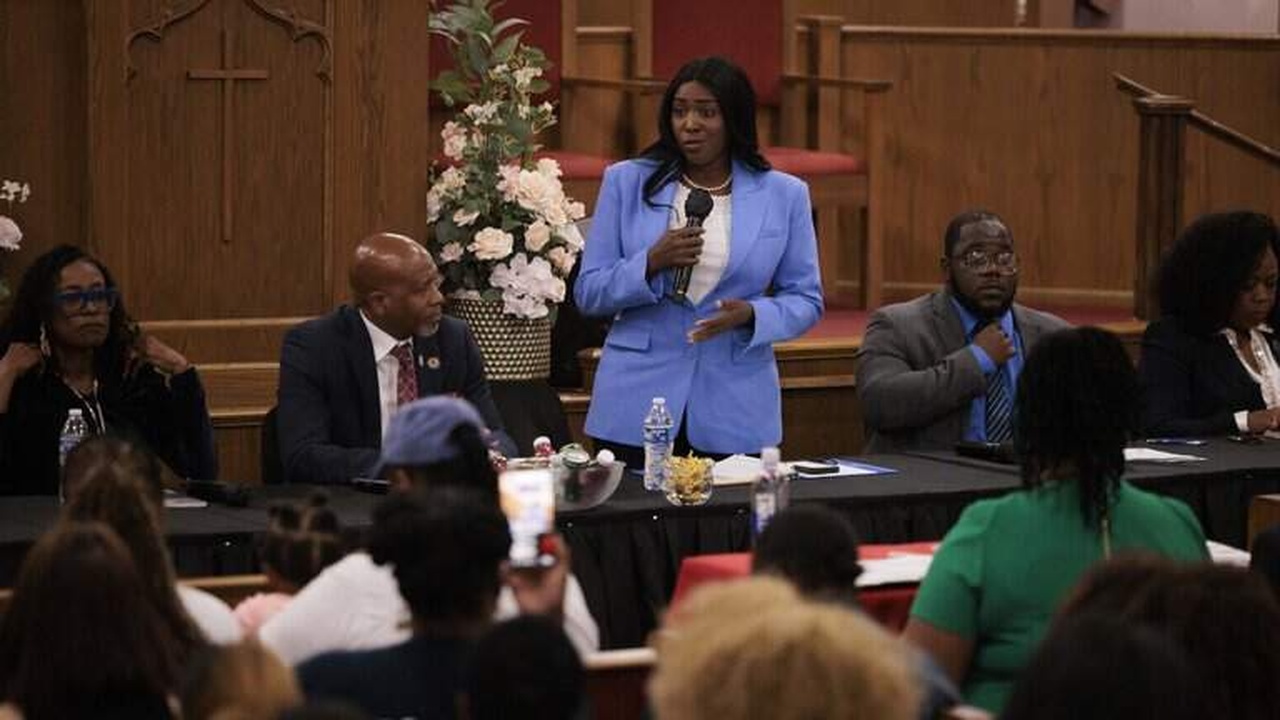
Another area of agreement: Miami-Dade’s public schools are “in trouble.” That’s why Joy L. Jackson, a 51-year recently retired teacher in the system, said she was running. “My why is because public schools are in trouble… Right now, we have cohabitation, we have student decline, there is a shortage of personnel, and God knows there’s a shortage of money,” Jackson said. The eight candidates spoke to a large crowd gathered at First Baptist Church Bunch Park. The event was hosted by the Miami-Dade branch of the NAACP. Among the attendees was Dr. Steve Gallon, the outgoing District 1 board member they’re seeking to replace. Gallon, who earned a seat on the county council this year having drawn no opposition after he filed for office, is supporting Wilson in the race. United Teachers of Dade, Miami-Dade’s public school teachers’ union, has endorsed Jackson. Is school choice a dirty word? Though the there was no love lost for the “Schools of Hope” law, candidates were more divided on the concept of “school choice” in general, often used to refer to policies allowing for charter schools or government-funded vouchers students can use to help fund their private K-12 schooling.
For some, “choice” was not a dirty word. James Wright, the former police chief and city manager of Opa-Locka, said he views the issue like he views competition in the security business he runs. “I do not complain about my competitors. What I do is I make sure that I’m providing the best value, the best service, and the best everything, so that there is not a question of what their choice is. So, the school board could adopt the same policy. How can we make ourselves the first choice for students in Miami-Dade County?” Wrendly Mesidor, a teacher at a local Catholic school, said he wasn’t against school choice, having graduated from a private school himself. He drew the line, however, at Florida’s universal voucher law. “I believe that parents should have the choice. But what I do have a problem with is some schools taking away from the public school,” Mesidor said. Wilson, who was principal of the Jeb Bush-backed Liberty City Charter School, the first charter school in the state, said she didn’t have a problem with school choice.
“If we’re talking daily about which grocery store that we’re going to go to, we’re going to go to the one that best serves us. So, I think that if we are concerned about it, we’ve got to look at the way in which we treat the customer we’re offering to, and ensure that our school environments are the ones that they choose,” Wilson said.
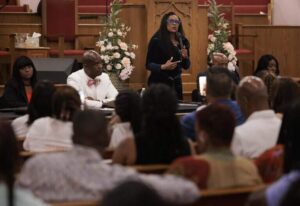
Joy Jackson, center, speaks during a forum for the candidates running for the Miami-Dade school board’s vacant District 1 seat on Wednesday, July 15, 2026, in Miami Gardens, Fla.
Linda Cothiere, a public school teacher, emphasized in her response that she’s “never worked for a charter school.”
Thera Johnson, a qualified write-in candidate, echoed the sentiments of many saying she’d push for Miami-Dade County Public Schools to be the place where “parents continue to choose to send their children” amid the reality of school choice. Throughout the forum, candidates carved out lanes that reflected their resumes. Cothiere brought her current teaching post up in many of her answers, Jennings focused on political solutions to many problems facing the district, Ighodaro highlighted his political and administrative experience, Jackson leaned into her many years as a teacher, Wilson stressed the diversity of her education and political resume, Johnson brought up her educational credentials, Mesidor relayed his classroom experience and Wright said he’d tackle problems head-on given his business and government background.
Other issues
School closures were roundly met with concern by the candidates. The school board recently OK’d closure, as recommended by the district’s Attendance Boundary Committee, of nine schools. Two of those schools — Parkway Elementary and Rainbow Park Elementary, a stone’s throw from where the forum was held — are in District 1.
“The closing of Rainbow Park was a huge issue for the community, and really, it somewhat caught a lot of people off guard because Rainbow Park has historical significance and meaning,” Wilson said. The closures have largely come in response to quickly declining enrollment numbers in most traditional public schools. Slowing birth rates have affected school districts across the country, and increased immigration enforcement has particularly hit Miami-Dade, officials say; school choice ventures like support for charter schools and universal private school vouchers could also play a role. The frustration around the closures coincided with a concern some candidates had about the treatment of District 1 compared to other districts in Miami-Dade.
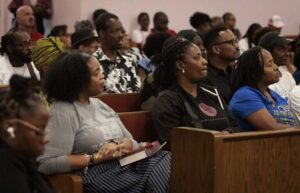
People listen during a forum for the candidates running for the Miami-Dade school board’s vacant District 1 seat on Wednesday, July 15, 2026, in Miami Gardens, Fla.
“You go to other neighborhoods, other communities, other districts, and you see tools that they have that we don’t have here. It’s an unequal distribution,” Jennings said.
On student achievement, candidates celebrated the district’s recent “A” grade — its seventh consecutive “A” designation — but all said there were ways to improve the current state of the school system. Wright suggested local schools may not have seen the gains that other schools in the district have seen while Ighodaro warned against “teaching to the test” as a distraction from better teaching strategies. Cothiere suggested expanding preschool opportunities, so children can begin reading at an earlier age. Wilson repeated her emphasis on cultivating a customer-oriented, highly organized culture in District 1 schools. When asked what role the school district should play in making immigrant children and families feel safe, all candidates were eager to offer support. The impending removal of deportation protections and work authorization under Temporary Protected Status for Haitian immigrants has worried many in South Florida. “No one is supposed to have fear to send their kids to school… This hit me really, really hard because I am a daughter of immigrants and I am an immigrant myself. Everyone has the right to feel safe,” Cothiere said.