

Polk school leader blasts County Commission for delay in placing tax referendum on ballot
The Lakeland Ledger | By Gary White | November 5, 2025
Leaders of Polk County Public Schools were caught by surprise when the Polk County Commission delayed transmitting a ballot measure that would allow voters to approve a property tax dedicated to raises for school employees.
No one from the district spoke at the Nov. 4 commission meeting, as PCPS officials expected the ratification to be automatic. Instead, commissioners questioned the need for the tax and said they would postpone a vote until January.
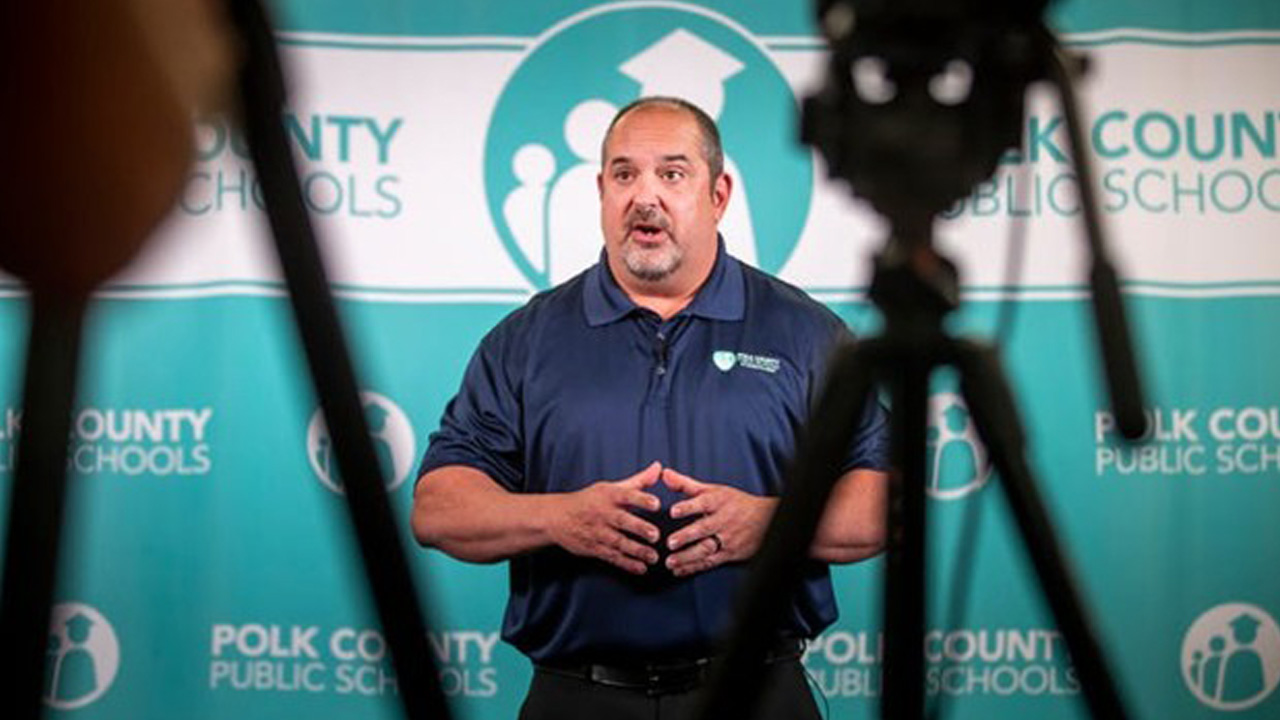
Polk County Schools Superintendent Fred Heid responded Nov. 5, expressing disappointment with the commission’s delay. Heid asserted that the County Commission is legally compelled to forward the referendum request to the Supervisor of Elections Office.
“Ultimately, we are confident that both legal precedent and state statutes show that the Board of County Commissioners is obligated to place the referendum on the ballot,” Heid said in a statement. “We remind the county that the Polk County School Board’s authority to govern public education derives from the Florida Constitution, as well as the Florida Early Learning-20 Education Code, and the School Board is a local government body of equal dignity, rank, and jurisdictional authority.”
By law, a taxing referendum from the school district has to be placed on the ballot by action of the County Commission. The commission has no authority to change or deny the referendum.
During discussions at the Nov. 4 meeting, Polk County Attorney Randy Mink told commissioners that the county could face “unnecessary litigation” if they avoided forwarding the referendum to the Polk Supervisor of Elections Office to be placed on the ballot for November 2026.
In his statement, Heid cited a court ruling in a lawsuit filed by the Hillsborough County School Board against the Hillsborough County Commission in 2023, after the panel declined to set a similar referendum. The Second District Court of Appeal ruled in favor of the School Board.
Heid also pointed to a state statute that gives school boards the power to direct a county commission to call for an election on a property tax proposal. The superintendent describes the Polk County Commission’s role as “purely ministerial,” language previously used by the courts, as well.
“The simple fact is that the Polk Board of County Commissioners must call for the referendum,” Heid wrote. ”For months, we have made this known to the County Commission’s legal office.”
Though the commission suggested it would wait until January to vote on the item, Heid said he expects commissioners “to honor their constitutional and statutory obligations” and vote on the item by their next scheduled meeting on Nov. 18.
Most funds earmarked for salaries
The School Board voted unanimously in April to draft a referendum, asking voters to approve a levy of one mill, or $1 for every $1,000 of assessed property value. The district estimates that the tax would generate about $80 million over four years.
The referendum language specifies how the revenue would be used. About 18% would be directed to charter schools, Heid said in his statement.
Of the remainder, 80% (or $53.1 million) would go to “school-based staff retention and recruitment bonuses,” Heid said. The final 20% would go to “special program supports for fine/performing arts, school safety and security, workforce development/career and technical education, early childhood development.”
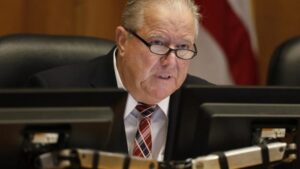
Polk County Commission Chairman Bill Braswell suggested during the Nov. 4 meeting that the Polk County school district had been “disingenuous” about the tax referendum.
More than half of Florida’s 67 counties have approved ballot measures that generate extra revenue for educational purposes, according to the Florida Education Association. Those levies are on top of the portion of property taxes that go to school districts’ general budgets.
In Hillsborough, more than 66% of voters approved an education tax referendum in 2024.
If the Polk referendum passes, the School Board will create an independent citizens’ oversight committee to review budget allocations, financial reports and funding priorities, Heid said.
The referendum was originally listed on the consent agenda for the County Commission meeting, the placement for routine items to be approved without discussion. Commissioner Becky Troutman asked at the Oct. 31 agenda review meeting that the item be moved to the regular agenda.
At the Nov. 4 meeting, commissioners expressed doubts about the need for the tax, even though their role is merely “ministerial.” Troutman asked if she could abstain from voting. Commissioner Bill Braswell accused the School Board of being “a little disingenuous” about the referendum.
“We’ve heard nothing from the School Board except put this on the ballot,” Braswell said. “This is saying, ‘We’re handing you a blank check, and you fill it in.'”
Heid said that the district “repeatedly asked” if it should have a representative at the Nov. 4 meeting, but commissioners never requested their presence.
“If a school representative needs to be present for the County Commission to fulfill its obligation to call for the referendum, we will be there,” Heid said in the statement. “We are more than willing to share information as to how the funds will be disbursed and audited by a community-based finance committee. However, this is neither required by statute, nor is this an indication of the school district seeking approval from the BOCC (Board of County Commissioners) for the referendum.”
Board member is ‘disappointed’
Two Polk County School Board members reacted to the County Commission’s delay.
“The Polk County School district has spent considerable time completing audits and needs assessments of this district,” Lisa Miller said in an email. “There is now time to share that information with the public before it goes on the ballot for the voters to decide. This procedure follows the requirements listed in statute. Polk County voters should have the final say in the investment they make into their schools and ultimately their workforce.”
Board member Justin Sharpless said he was “disappointed” at the commission’s delay. He repeated Heid’s assertion that the commission is legally obligated to approve placement of the referendum on the ballot.
“The BoCC’s decision to intentionally delay this vote damages the ability of Polk’s voters to become educated on the referendum,” Sharpless said by email. “Additionally, this action usurps the Polk County School Board’s authority in bringing this item to the voters.”
Sharpless added: “The Polk County School Board has publicly discussed the millage referendum for well over 6 months. At the meetings where this item has been discussed, we welcomed public comment and listened to our constituents. To act like this is a surprise would be disingenuous.”
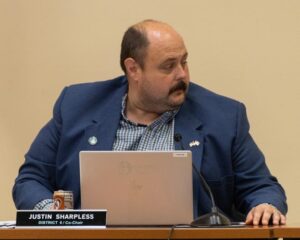
Polk County School Board member Justin Sharpless expressed disappointment with the Polk County Commission over its delay in transmitting the ballot measure to the Supervisor of Elections.
Kay Fields said by text message that she was not available to speak. The three other School Board members — William Allen, the chair; Travis Keyes; and Sara Beth Wyatt — did not respond to messages left the morning of Nov. 5. Braswell did not reply to an email sharing Heid’s statement.
During the commission meeting, Braswell mentioned a half-cent sales tax that generates funds for school maintenance and construction. He suggested that the district revise that levy to create additional revenues.
The referendum establishing that tax, passed by voters in 2018, specified that the revenue could not be used for operational expenses, such as salaries.
Polk is the only county in west Central Florida that does not have a property tax assessment devoted to increased pay for public school employees, said Stephanie Yocum, president of the Polk Education Association, which has pushed the proposal for years. Yocum, whose union represents about 70% of PCPS employees, suggested that county commissioners committed an ethics violation in not voting on the agenda item.
“They know that they’ve just got to pass it to the supervisor, and then for them to sit there for probably about 15, 20 minutes, berating the school district for not being there and (saying) they don’t even know what this money is for, is a bald-faced lie,” Yocum said. “They are cowards and they are liars, because they knew exactly what this is for, how the money would be spent.”
Political calculations at work?
Yocum said she suspects that commissioners were afraid of incurring the wrath of Florida Gov. Ron DeSantis, who is advocating for the repeal of all property taxes. All the commissioners are Republicans, as is DeSantis.
In pushing the district to craft a referendum, Yocum has argued that Polk is losing teachers to neighboring counties that offer better salaries because they have such taxes in place.
Local Republicans criticized the proposed referendum in an email discussion that a Ledger reporter was included in. Ed Shoemaker, state committeeman for Polk County to the Republican Party, acknowledged that the commission is obligated to transmit the item to the supervisor’s office.
But Shoemaker said he was “deeply troubled” by the School Board’s referendum push. He claimed that the proposal was “vague” and that teachers would not be guaranteed to receive raises.
Shoemaker called for Florida Chief Financial Officer Blaise Ingoglia to conduct an audit of Polk County Public Schools, implying that the district is not operating efficiently.
Sam Romain, chair of the Polk County Republican Executive Committee, seconded the call for a “full financial and operational audit before anyone considers burdening property owners further.”
The Florida Department of Education requires school districts to conduct annual financial audits. The agency itself leads the reviews at least every three years for larger districts, including Polk County.
“They’ve done efficiency audits, and the problem is not that we are wasting money, because I’m going to tell you, I pull apart their budget every year,” Yocum said. “There’s not a lot of waste. And in fact, there’s deficit spending, because we are not funded appropriately by the state, which is why this millage is necessary.”
Union members plan to attend the Nov. 18 County Commission meeting and urge commissioners to “do your job,” Yocum said.