


Volusia Schools’ administrative costs rise, bucking a trend, while enrollment stagnates
The Daytona Beach News-Journal | By Gabriel Velasquez Neira | August 20, 2025
Volusia County faced stagnant enrollment in 2024, but reported an increase in administrative costs, according to data required by the Educational Accountability Act and distributed by the Florida Department of Education.
The administrative spending increase bucks a trend. Over a nine-year trend, costs peaked at 33% in 2020, the year that the COVID-19 epidemic hit, and dropped to 10% in 2023. The number for 2024 was 15%, according to the data.
Over the long haul, from 2015 to 2024, the Volusia County School District has seen a $6.5 million increase in administrative costs, when adjusting for inflation, while the number of full-time students dropped by more than 1,800.
Schools administrative costs slightly above state average
The administrative cost increases were slightly above the state average over nine years, with Volusia ranking 23rd-highest out of 65 counties, compared to the rest of the state. (Gadsden and Jefferson counties were removed due to faulty data.)
In the data released by the education department, the number of students enrolled is categorized as “unweighted full-time-equivalent students,” which excludes students in charter schools or students who receive vouchers under the Family Empowerment Scholarship and/or McKay Scholarship.
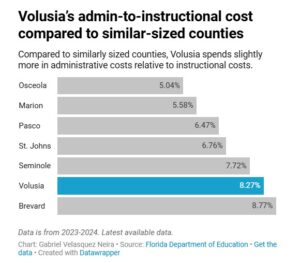
So, while Volusia’s administrative costs have been growing and outpacing Florida’s average, Volusia is only slightly above average in its administrative to instructional spending ratio (31st out of 65 counties), according to an analysis by The News-Journal.
For reference, Polk County, which spends the lowest percent on administrative costs relative to instructional costs, spends only about 4.7% of its budget on administration. Franklin County spends the highest percentage on administrative costs relative to instructional costs, spending about 19.2%. Volusia is at about 8.27%
Enrollment lagging at Volusia schools
Stagnating enrollment isn’t unique to Volusia. Statewide, the number of students in Florida’s public education system has been static, thanks largely to the expansion of school choice initiatives.
In 2001, the Florida Legislature established the Florida Tax Credit Scholarship Program (FTC) to give lower-income families more educational opportunities. Initially, the program required income verification, but Gov. Ron DeSantis removed the financial eligibility requirements in the 2023-2024 school year.
Personalized Education Program (PEP) and Family Empowerment Scholarships also led to expanded options for parents. In essence, the programs and other incentives create incentives for parents to seek schooling options outside of public schools.
“Over the course of the years, the legislature has increased the amount of scholarships available to parents in the state, when at its inception it had income verifications,” John Cash, chief of staff for Volusia County Schools, said. “But then those income verifications are no longer in place, and they have continued to increase the PEP scholarships every year.”
Cash said that means that as enrollment in the program increases, fewer parents will send their children to public schools, meaning less money will flow into the district’s education system.
And the census data backs it up. From 2015 to 2023, the school-age population (5 to 17-year-olds) has increased by about 4,500 or 9%, according to the American Community Survey five-year data. Meanwhile, the number of full-time students enrolled in the district decreased by 1.3%.
The lower number of enrolled students has already affected the district’s budget.
“When it materialized and there was a bigger growth in the scholarship program,” said Todd Seis, the chief financial officer for Volusia County Schools, in a June 24 workshop meeting with the school board. “We planned for that reduction in revenue…and we just gave it back to the Department of Education.”
So why have costs been increasing when enrollment hasn’t?
Federal and state laws have forced districts to evolve and, as a result, spend more money.
For example, Alyssa’s law, which was named after a 14-year-old who died during the Parkland school shooting, forced districts to have panic alert systems. Drills and training for staff also increased costs, according to Seis.
Another example is having an internal auditor for districts with over $500 million in annual revenues. Volusia outsources the job to an external firm, but it also led to increased costs.
“The additional requirements established in 2018 have created the need for coordinated support across multiple departments,” Seis wrote in an email to The News-Journal, “including fiscal services, to ensure that internal auditors receive the information they need to complete their reports.”