


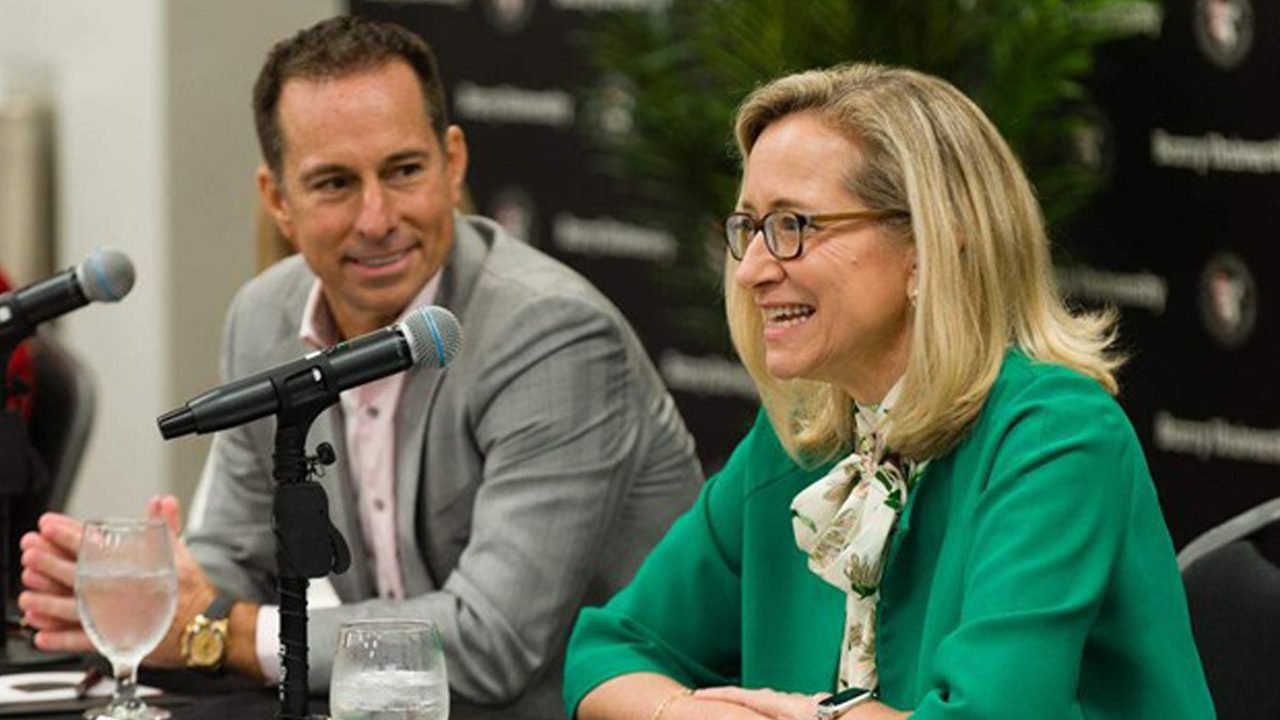
‘A win-win’: Barry University, Miami Country Day announce athletics partnership
Barry University and Miami Country Day School’s campuses are located roughly a mile from each other.
It often works out great when neighbors can help each other out.
Such is the case when it comes to each school and their athletic programs in the near future.
Barry University and Miami Country Day formally announced a long-term strategic partnership and use agreement to share access to each other’s athletic facilities in an effort to enhance opportunities for student-athletes at both institutions.
The announcement was made earlier this week at a ceremony held at Barry and attended by student-athletes from both schools as well as local elected officials, trustees, and community leaders.
“We’re really excited about this partnership with Miami Country Day, which is such a well-respected institution,” Barry University President Dr. Mike Allen said. “As we looked at both of our situations, we saw some important needs we both needed to address. This was a great example of a higher-education university and a local independent school coming together and making something really exciting happen for both schools.
“It’s really a win-win.”
As part of the agreement, Miami Country Day students will utilize Barry’s fields and training centers, including soccer, baseball, softball, lacrosse, and other turf sports. In turn, Barry student-athletes will have access to Miami Country Day’s swimming facilities, strengthening training opportunities for the Bucs’ nationally-recognized Division II athletics programs.
“Our school is expanding and there’s a real demand for enrollment for private schools in South Florida in general. We realized we needed more opportunities for our student-athletes. We’re building a new athletic center on campus, which will open in December,” Miami Country Day President and Head of School Mariandl Hufford said. “Barry University has long been a partner of ours and we have deep connections with them. Dr. Allen is one of our trustees and they’re in our neighborhood. They had the land and we were looking for an opportunity. We said this partnership should survive all of us and we knew we needed to do this for generations of students to come from both schools.”
As part of the partnership, MCD student-athletes will have four-hour access to the athletic fields every day of the week.
The deal will also give Barry University the facilities to host their new men’s and women’s lacrosse and women’s flag football programs and make them official sports at the school.
Barry has added eight sports in the past two years. This will allow the school to increase up to 11 sports overall.
“It started as we needed to solve a problem and it turned into a world of opportunity,” Hufford said. “We want to provide the best environment for our young people to grow and thrive.”
Planned upgrades include construction of two athletic fields with one jointly used and lined for baseball, softball, lacrosse, soccer, and flag football, and the other designated exclusively for Barry and lined for soccer, lacrosse, and flag football with an adjacent sprint track.
Both will feature turf made of 100 percent cradle-to-cradle sustainable materials, incorporating approximately 800,000 recycled plastic bottles per field. The enhancements also include elevated press boxes, scoreboards, and broadcast-capable LED lighting, along with batting cages, a lacrosse practice wall, and upgraded player areas.
Construction is expected to begin in January and the goal is for the new facilities to be usable by the fall of 2026 around the time the next high school calendar year begins.
“It’s going to help a lot of our teams and it’s great to see it all come full circle,” said Miami Country Day athletic director Chuck Sennett, who played baseball at Barry University in the late 1980s. “We’re getting ready to build a new upper school in our baseball/softball area so it allows us an opportunity to keep those programs going at a world-class facility. We can continue to build those programs without having to worry about where they will be, and the chance for our athletes to watch how college athletes train and compete is a great opportunity.”