

Exclusive: High School Redesigns Curb Enrollment Loss, Report Finds
The 74 | By Linda Jacobson | April 23, 2026
But a ‘critical mass’ of students need to participate in career-focused programs for districts to stay competitive, researchers say.
Like many adults, Brooke Davis spent much of her college years preparing for a career she later realized wasn’t for her. She eventually switched her major from marine biology to engineering, but she didn’t want her daughter to make the same mistake.
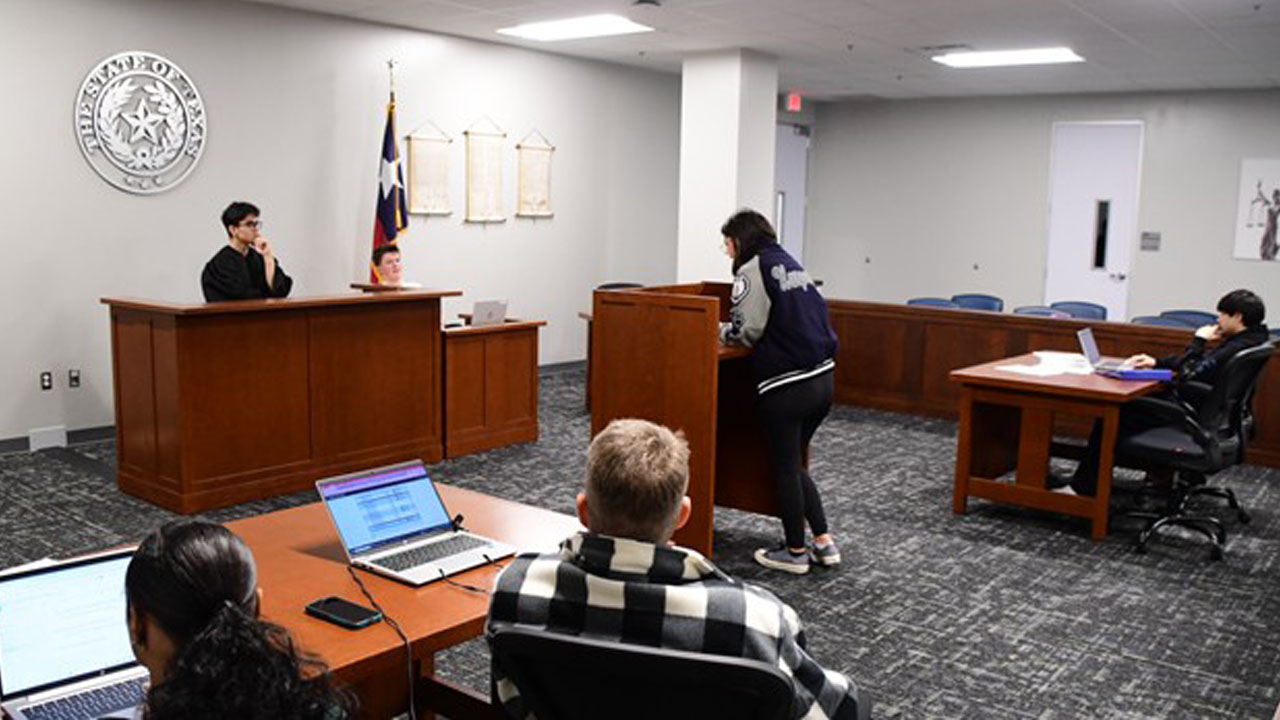
That’s why she’s grateful that her 11th grader Kai can explore a career field at her high school in the Tomball Independent School District, outside Houston. Kai is in the legal studies program, which meets daily at the Tomball Innovation Center, a 70-acre facility that houses programs like aviation maintenance, cybersecurity and app design.
“For her to just get her feet wet and see if it’s something that she might want to do for the rest of her life is awesome,” Davis said. “You don’t want to go into something in college and then all of a sudden not understand what it is you’re getting into.”
Programs like Tomball’s are helping to keep some families in public schools at a time of rapidly expanding private school options, according to a new report from Tyton Partners, a consulting firm that focuses on the education sector. Enrollment in the district has climbed from 10,000 to nearly 24,000 students over the past decade, even as many others in the Houston metro area have continued to lose students. The report attributes such increases to career-connected high schools that not only reflect student interests, but that are popular with both kids and parents.
“Everyone’s looking to create fun, interesting new programs. In fact, there are probably too many of them,” said Adam Newman, Tyton founder and managing partner. Instead, districts should focus on making sure a “critical mass” of students participate in high school redesign initiatives for those programs to “remain compelling for parents” and attract growth, he said.
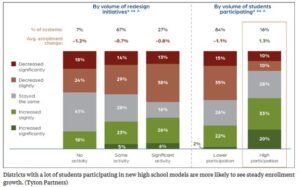
A survey of 250 high school administrators showed that more than half of districts and charters with high participation in redesigned programs saw enrollment growth between 2022 and 2025. Those with minimal participation continued to see enrollment decline.
But that hasn’t been the problem in Tomball. The demand to enroll in classes at the career and technical education facility, a former headquarters for an oilfield services company, is so great, the district holds a lottery to admit students. With an actual courtroom on site, Kai, who attended a classical Christian school for K-5, has been able to observe traffic court. She’s learning how to prepare oral arguments and properly cite case law.
“They teach you about how to think like a lawyer,” she said. “I feel like I’ll definitely have a leg up once I get to college.”
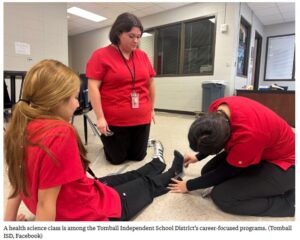
Other students can earn a pilot’s license when they graduate or leave with an industry certification in fields like animal science or graphic design. Those in the health care P-TECH program, an early college model, will complete an associates degree along with a high school diploma.
With HCA Healthcare nearby and Eli Lilly and Company building a branch of its pharmaceutical business in Houston, Tiffani Wooten, assistant director of the Tomball Economic Development Corp., said P-TECH helps “fast track” kids into in-demand careers.
Health care is a “huge growing industry that we’re going to have to continue to filter kids in,” she said. She describes her role as a “connector” who works with the district to “bring the industry to the table.”
Christian Lehr, managing director at Tyton, said the district views “career-connected pathways as a core enrollment and value proposition strategy,” instead of as an add-on.
‘Enrollment pressure’
The report is a departure for Tyton, which has focused most of its analyses in recent years on efforts to disrupt the public education system. In 2022, it released survey data showing a one-year, 9% drop in families saying their children were enrolled in a traditional district school. Charters, private schools and homeschooling saw increases over that same time period.
In a deeper look at school choice, Tyton researchers reported in 2024 that improving their children’s mental health was the main reason why parents considered leaving the traditional system for alternatives like online programs and private schools.
This year, the team “turned the lens back to the public system because many of them are grappling with enrollment pressure,” Lehr said. With AI changing the workplace, they’re also thinking about the “shift from a college-for-all, No Child Left Behind mentality.”
There are plenty of reasons to rethink education for teens, said Celina Pierrottet, who leads a high school transformation project with the National Association of State Boards of Education.
In a 2024 poll from Gallup and the Walton Family Foundation, less than half of students said their schoolwork was challenging in a positive way or matched what they do best. Forty-six percent of 12- to 27-year-olds, including those in K-12, said they weren’t having any engaging experiences at school. Chronic absenteeism also remains higher than it was before the pandemic.
“There are a lot of warning signs flashing that high schools need to change,” Pierrottet said.
‘A long journey’
The Tyton project, funded by the Walton Family Foundation, also includes brief case studies of districts and charter networks to identify some common redesign elements, like getting input from students on what they want and relying on outside groups, including employers and nonprofits, to execute the programs.
The pattern revealed itself in Arizona, where over 100,000 students participate in the state’s universal private school choice program. Enrollment in the Vail School District, outside Tucson, has increased 4.3% since 2022. While new housing development in the area has contributed to growth, enrollment increases have outpaced that of the high school-aged population.
The Tyton report also features the Anaheim Union High School District in California, which used state funds to remake secondary schools and re-engage students. District leaders took the focus off testing and designed courses like biotech chemistry that link academic content with job skills.
One school launched a community gardening project that’s used for instruction across the curriculum. But getting the community to notice can be “a long journey,” Lehr said. The Anaheim district has been at its redesign work for a decade.
In a state where public school enrollment is expected to keep dropping through the end of the decade, the Anaheim district has seen a slight decline since 2022.
“The key question is whether execution holds,” Lehr said. “If it does, we’d expect stabilization and ultimately growth over the next five years.”