

Lee County teacher jobs at risk amid $46.7M school budget shortfall
Some teachers won’t return to Lee County classrooms next year.
The Lee County School District has started issuing preliminary notices to staff that their contracts may not be renewed as part of a broader budget realignment.
The move comes as the district prepares for the 2026–27 school year while working to close a projected $46.7 million budget deficit driven by declining enrollment, inflation and the expansion of state school choice programs.
Employees on annual contracts are being notified this month if their positions are being cut or if their contracts will not be extended past their June 30 expiration, district officials confirmed.
Riley Kempton, a district spokesperson, provided a statement explaining the current status of these notices.
“As we are realigning our school budgets to match state funding, yes there have been staff that have been told their contract will not be renewed; those notices are preliminary per their contract they are employed through June 30th,” she said in an email to The News-Press & Naples Daily News.
The district describes this process as a correction to ensure school staffing reflects actual student enrollment.
“The state allocates a specific amount of funding per student, and some schools have been staffed beyond what that funding can sustain,” district spokesperson Rob Spicker said. “This realignment corrects that imbalance so that every school’s staffing reflects the students it actually serves today.”
How does the state budget factor in?
The Florida Legislature has not yet finalized a state budget for the upcoming fiscal year.
Teachers Association of Lee County (TALC) President Kevin Daly said lawmakers have missed their primary constitutional obligation and have yet to complete a budget.
“Legislators in Tallahassee have one constitutionally assigned job, and that is to pass a budget, and they have not yet,” Daly said. “They went the whole session without passing a budget. I don’t think they’re even going to take it up until June.”
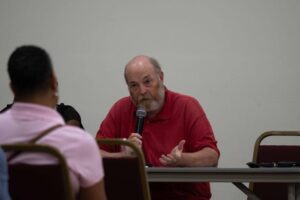
Kevin Daly, president of the Teachers Association of Lee County, speaks with community members during an education town hall at the Quality Life Center of Southwest Florida in Fort Myers on Oct. 27, 2025.
Because state education funding is determined by the Legislature, Daly said the delay leaves districts operating without firm numbers. He said schools have instead been working off preliminary budgets based on projected enrollment, which he argues has contributed to early staffing decisions before final funding levels are known.
The district, however, said staffing and budget realignment decisions are not being driven by the state delay. Kempton said the current process reflects long-term local planning.
“State budget uncertainty is not driving staffing decisions at this time,” she said. “The district’s realignment work is grounded in its own long-term financial planning.”
The delay has also complicated contract negotiations between the district and the teachers’ union. Daly said discussions over compensation are effectively on hold without a final state funding figure.
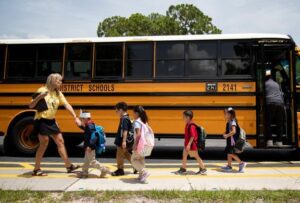
Students walk to their buses at San Carlos Park Elementary School on Wednesday, Aug. 10, 2022.
“We can’t even talk about anything that has to do with money because Tallahassee hasn’t done what they need to do,” he said. “Everybody’s gone by then, so now we can’t even vote on it until August.”
Daly added that local districts should be pressing state lawmakers for clearer timelines and more certainty as they plan budgets.
“Honestly, the district should be mad, too,” he said. “Tell me what my budget is so I can plan everything I need to plan realistically, not just what we think it’s going to be based on the past.”
What’s driving the projected budget deficit?
District budget outlook documents point to several “fiscal realities” causing the current financial pressure. Enrollment in traditional public schools has declined while participation in the Family Empowerment Scholarship, a state voucher program, has grown rapidly. Because state funding follows the student, the district loses revenue when children leave for private or home school options.
At the same time, the district is working to reduce its reliance on roughly $45.4 million in capital fund transfers used to support general operating costs. The district describes this as a “sustainability mindset,” meant to eliminate non-essential spending to protect teacher investments and the classroom environment.
“The district must exercise rigorous fiscal discipline to protect the classroom and achieve its goal of becoming an ‘A’ rated district while navigating significant financial pressures,” the district states on its website.
How is the teachers’ union responding to the cuts?
Daly said the “depth of the non-renewals” appears significant across various schools. He noted that while non-renewals occur every year, the scale this year appears more widespread. He indicated that the district has moved away from previous collaborative agreements that established an “order of operations” for staffing reductions.
“They are kind of following the letter of the law, which means if you’ve been an annual contract teacher with the district since 2009, and you’ve been highly effective every year, and somebody else is a second-year annual contract teacher, they cannot renew you and keep them,” he explained.
Daly shared his concern that telling teachers about non-renewals early in April may cause them to seek jobs in neighboring districts like Collier or Charlotte before Lee County can determine whether vacancies from retirements might have saved their positions.
Will class sizes or student extracurricular programs be affected?
The district maintains that families and teachers should not expect changes to class sizes as a result of these staffing corrections. On its fiscal discipline website, the district shared that school-level decisions are handled individually to reflect each school’s unique needs rather than through a one-size-fits-all directive. However, union representatives and some teachers expressed concern that classrooms will become packed and overcrowded as a result of the cuts.
There is also uncertainty over the future of arts and extracurricular programs. While the district says its commitment to a well-rounded education remains firm, Daly noted that when building-level administrators are forced to cut positions, academic roles are often prioritized over arts programs.
“We hear you, and we want you to know: our programs will remain. Arts, athletics, and extracurricular activities will continue. Services will keep being provided,” the district posted on social media Tuesday, April 21. “The delivery model may evolve as we make sure every school is staffed in a way that reflects the students it serves today, but the district’s core mission does not change. Every Lee County student will continue to have access to the opportunities they deserve.”
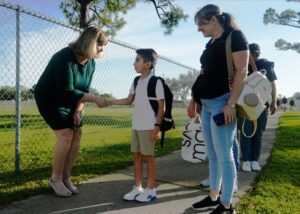
Lee County Schools Superintendent Denise Carlin greets incoming student Carlos Suarez at Trafalgar Elementary School in Cape Coral Monday, August 22, 2025. Lee County’s public schools began the new academic year Monday.
What is happening at the top?
Superintendent Denise Carlin said the central office must model the way in fiscal responsibility before asking schools to adjust.
As part of that approach, the district directed all central office departments to cut 5% from their budgets in March 2025, generating about $15.9 million in savings. A hiring freeze for central office staff was also implemented that same month to further save costs. The freeze did not apply to school-based positions like teachers, bus drivers or food service workers.
For the 2026–27 budget cycle, district officials are proposing an additional $6.5 million in administrative reductions as part of the broader “Sustainability Budget” plan. This effort, led by Chief Strategy Officer Kenneth Savage, includes an eight- to 12-month department-by-department review of staffing and spending.