

Lee schools seek $17M in federal funds for security upgrades, safer entrances
News-Press | By Mickenzie Hannon | May 20, 2025
As the School District of Lee County works to finalize its upcoming budget, officials are eyeing more than $17 million in federal funding to support safety upgrades at dozens of campuses, part of a broader $50 million infrastructure push, while the state’s final education budget remains unsettled.
At a school board workshop and meeting May 6, district officials outlined two major Community Project Funding requests aimed at replacing outdated intercom systems and building secure vestibules at schools lacking proper entry security.
“Safety is our district’s number one priority,” said Krissy Houlihan, the district’s government relations director. “With increasing threats in incidents nationwide, we must be proactive rather than reactive in protecting our schools.”
Lee County Schools unveil new weapons detection system ahead of 2023 school year.
Why is the district requesting federal earmarks?
The district is leveraging the earmarks process, where members of Congress submit project-specific funding requests through the House and Senate Appropriations Committees, to directly secure money for high-priority capital needs.
Each House member is limited to 15 requests, and Lee County submitted two through U.S. Reps. Byron Donalds and Greg Steube, focusing on projects located primarily within Donalds’ district.
The first request is for $7 million to upgrade intercom systems at 57 schools. The project aims to replace outdated systems to improve emergency communication, better integrate with panic alert technology and meet compliance standards such as Alyssa’s Law, which requires silent panic alarms in public schools to directly notify law enforcement during emergencies.
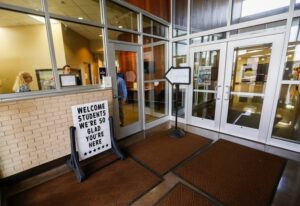
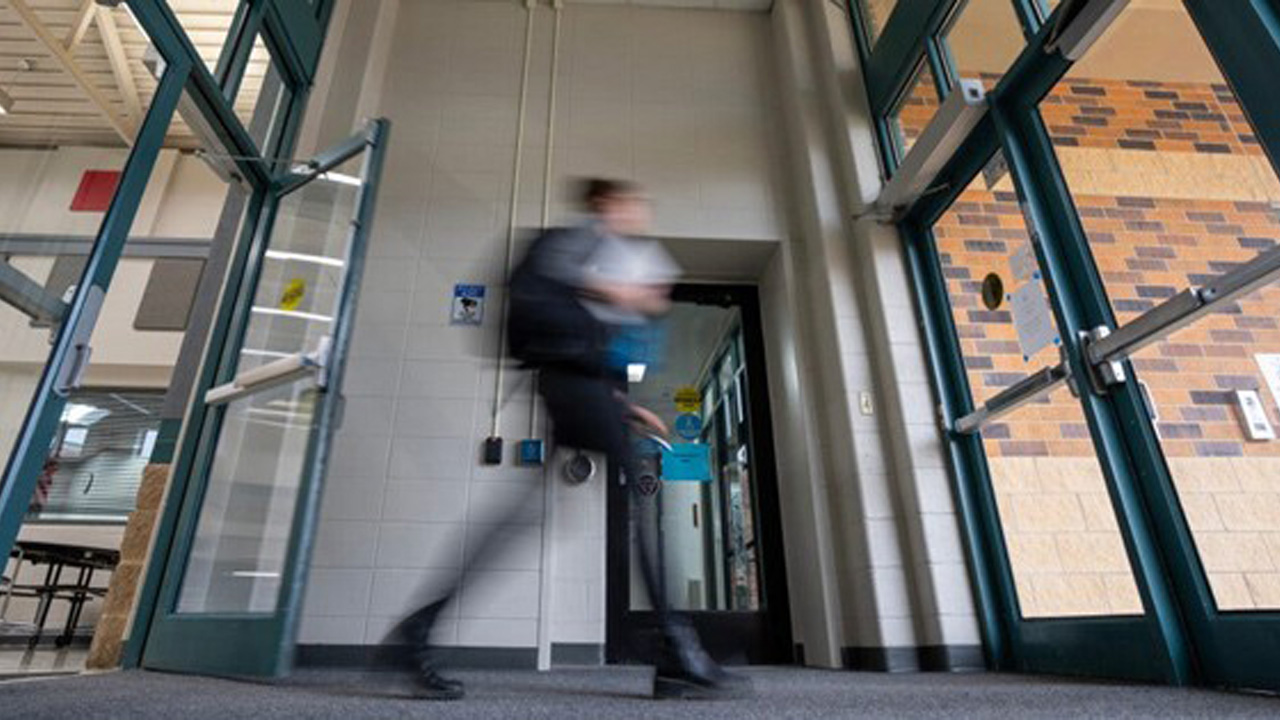
When visitors walk through the door at Jeffries Elementary School, they are in a secure vestibule next to the main office.
The total cost of the intercom overhaul is projected at more than $50 million, with the district already committing over $43 million, a local investment that officials say shows strong financial partnership.
The second request seeks $10.05 million to install secure vestibules, which are interior holding areas between a building’s exterior entrance and its main hallway, at 65 schools that currently lack them. These entry upgrades provide an additional layer of screening before visitors gain access to a campus, helping slow intruders and give staff more time to respond during emergencies.
The vestibule project is estimated to cost $23.4 million total, with more than $4.3 million already committed locally.
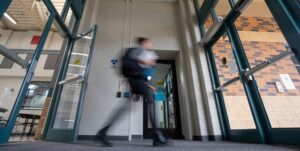
The vestibule to the secure entrance to Mount Horeb Middle School is shown Wednesday, February 26, 2025 in Mount Horeb, Wisconsin. Last May, a 14-year-old student attempted to bring a rifle into the school, but he was unsuccessful. The district superintendent has said lives were likely saved that day because the school district had used referendums to upgrade the building to have a “secure entrance” and other safety features.
Who’s leading the charge in Washington?
The district’s lobbying team from Ballard Partners, including Dan McFaul and Tracie Pough, explained the earmark process is still ongoing, with final decisions likely months away.
“The federal appropriations process is ongoing and complex,” said McFaul, adding that decisions could come as late as December 2025 or even early 2026 depending on how the budget reconciliation process unfolds in Congress.
Pough clarified that while school infrastructure may sound like a Department of Education issue, these safety projects fall under the U.S. Department of Homeland Security’s purview due to their focus on physical security.
“It’s really important to have access to people who have their finger on the pulse of all the change and influence,” McFaul said, describing the lobbying firm’s role in navigating Capitol Hill dynamics.
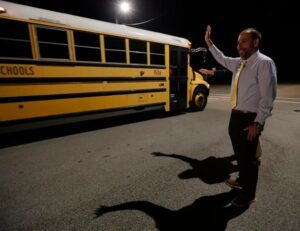
Sam Fisher, chairman of the Lee County School Board, waves to school bus drivers as they depart the west zone bus compound in Cape Coral for their routes Monday morning, August 12, 2024.
Why send the board chair to Washington?
To strengthen its advocacy efforts, the board approved travel expenses for Board Chair Sam Fisher to accompany district staff and lobbyists to Washington, D.C., where they will meet with lawmakers to promote the district’s federal priorities.
Board member Debbie Jordan questioned the need for such trips, given the cost and presence of paid lobbyists already working the Hill.
Others, however, argued the presence of the board chair or superintendent during meetings with congressional offices carries more weight.
“It just makes a better impression,” Armor Persons said. “When we go up there to try to get them to fund these million-dollar projects, it’s important either to have the superintendent or to have the chair along with some staff.”
Board member Bill Ribble agreed. “It makes a statement when we have someone there with authority representing us, like the board chair or the superintendent of schools,” he said.
Teachers plead with board: ‘We are asking for respect in the form of fair pay’
Beyond infrastructure and safety needs, community members raised concerns about how the budget prioritizes staff.
Several current and former teachers urged the district to increase teacher pay, arguing that current salaries are not competitive and do not reflect the rising cost of living.
One teacher, Christina Chuderski, said her base salary remains below the district’s advertised midpoint even after more than two decades in the classroom. She criticized the district’s offer of a 3% cost-of-living adjustment and claimed the district had overbudgeted salaries by an average of $38 million annually over the last decade.
Latonya Starks, a teacher and member of the teacher’s union, TALC, echoed the claim of overbudgeting and asked the board to reassess its priorities.
“We’re not asking for handouts. We are asking for respect in the form of fair pay,” Starks said.
Charla Fox, who has taught in the district for 24 years, said she was forced to leave teaching for 15 years because she couldn’t afford to stay in the profession.
“I could not afford to stay teaching and actually make a living,” she said, adding that too many teachers are having to work second and third jobs just to make ends meet. “I am asking you to be brave, and I’m asking you to work in finding funding,” Fox said to the board.
The district is exploring alternative staffing models, including virtual roles, to help fill critical positions such as school counselors and specialists, officials said.
What’s next for the budget?
Though the district has outlined its spending priorities, Florida’s state education budget remains in flux, complicating Lee County’s ability to finalize its local budget.