
Local Services for Florida Children and Parents Would See Deep Funding Cuts Under Amendment 3
Florida Policy Institute | By: Norin Dollard, PhD | September 10, 2026
Key takeaways: Amendment 3 would put local funding at risk for Children’s Services Councils and Trusts (CSCs) that exist in 14 Florida counties. If the amendment passes, CSCs stand to lose $100 million in Fiscal Year (FY) 2027-28 and $278.1 million over the next two fiscal years, FY 2027-28 and FY 2028-29.
In response to Gov. Ron DeSantis’ call for a special session on property taxes, the Florida Legislature passed House Joint Resolution (HJR) 1-F — and its companion Senate Bill (SB) 4-F — which would increase the state’s homestead exemption, reduce the assessment growth cap on non-homesteaded properties, and create a pathway for the full elimination of non-school property taxes on homesteads. The proposed amendment to Florida’s constitution will be in front of voters in the upcoming November 2026 general election.
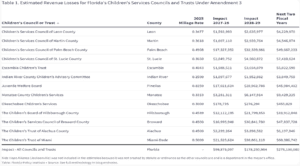
Though services vary according to the needs of local families and their communities, Children’s Services Councils and Trusts (CSCs) provide critical services in counties across Florida, including out-of-school programs, child care, and early learning as well as neighborhood resource centers that provide parenting supports, wellness screenings, and can serve as gateways to child services. If Amendment 3 passes, CSCs would lose almost $278.1 million in the next two fiscal years,[1] 15 percent of total revenue, putting these services at risk of funding cuts or elimination. Table 1 below highlights these losses.[2]
Services provided by local CSCs are community staples that contribute to the healthy development of children in Florida. Children, families, residents and professionals in each community benefit from services that range from universal wellness checks to specific supports such as tutoring, child care, and summer camps. The array of services that CSCs offer include universal services available to all children, as well as targeted services for specific groups such as children with disabilities or children in certain zip codes. CSCs also improve public safety by providing structure after school for youth.
If Amendment 3 passes, CSCs would lose almost $278.1 million in the next two fiscal years, 15 percent of total revenue, putting these services at risk of funding cuts or elimination.
Amendment 3 offers no alternative sources of revenue to replace these important services for Florida’s children, families, and communities, and the CSCs themselves are constrained by a maximum millage determined in statute or the local ordinance that created them. Therefore, if the proposed amendment passes, it will result in a significant loss for these communities.
About Children’s Services Councils
Florida has different types of “special districts” that provide dedicated funding for things like water management, mosquito control, some libraries, and importantly, CSCs. These councils and trusts are an essential part of the support ecosystem for children and families in 14 Florida counties, in which more than half of Florida’s children reside.[3] CSCs are approved by voters and provide dedicated funds for services that complement school and county human services. Funding for CSCs, currently estimated at more than $900 million annually statewide[4] for FY 2027-28, primarily comes from non-school property taxes. As such, their revenue would be sharply reduced were property taxes to be reduced or eliminated. Over the next three years, total revenue would exceed $1.8 billion without any changes to current tax millage. By law, special district funding is not easily redirected to other uses — unlike other public funding streams — and must not be used as a substitute for new or existing resources for children’s services.[5]
The service array funded by the CSCs is determined by county residents and county data, such as that contained in needs assessments. Services vary from county to county and can include out-of-school and afterschool care, behavioral health services, and child care. One way that the CSCs fund child care locally is by providing local match dollars that draw down $30 million in state[6] and federal funds annually, so that early learning coalitions can provide more child care to qualified children. The cost of CSCs to taxpayers is minimal and ranges from $25 to $80 per taxpayer annually depending on the county and on the property’s value.
This loss of revenue will be detrimental to the services available in these communities given budgetary uncertainty and proposed deregulation at the federal level, flat budgets, or budgets that rise at less than the rate of inflation at the state level for things including child care and rising costs that cut into family budgets.
In an environment of uncertainty at all levels of government, Floridians cannot afford property tax reductions and elimination and the steep service reductions that will result.
Children’s Trust of Alachua County
Total Estimated Impact, FY 2027-28 and FY 2028-29: $6,197,846
The Children’s Trust of Alachua County was approved as an independent taxing authority by voters in 2018. In 2025, the children’s trust served more than 27,000 children, parents, and other working professionals. Supports provided included doulas for the community, birthing support, child care tuition assistance, and teen work and leadership programs. The trust can levy up to 0.5 mill and had an estimated revenue of more than $8 million in 2025.
The passage of Amendment 3 would mean that the trust would be poised to lose $2,299,264 in FY 2027-28 and $3,898,582 in FY 2028-29, representing a total loss of $6,197,846 in the next two fiscal years.
Broward County’s Children’s Services Council
Total Estimated Impact, FY 2027-28 and FY 2028-29: $47,837,728
The Broward County Children’s Services Council was established by voters in 2000 and reauthorized in 2014. In FY 2024-25, the Broward County CSC funded more than 100 community partners countywide, serving nearly 200,000 children[7] in areas of delinquency prevention and diversion, early care and education, supporting healthy youth, maternal and child health, and more. This support totaled $127.6 million last fiscal year.
If Amendment 3 passes, the Broward County CSC will lose $16,995,948 in FY 2027-28 and $30,841,780 in FY 2028-29, totaling $47,837,728 in the next two fiscal years.
Escambia Children’s Trust
Total Estimated Impact, FY 2027-28 and FY 2028-29: $5,022,590
The Escambia Children’s Trust was approved by voters in 2020. In FY 2024-25, the Escambia Children’s Trust collected $12.9 million in total revenue, and $10.4 million was spent on grants and contracts to service providers in the community who focus on out-of-school programming for more than 2,300 children. Additionally, through this funding, 950 children received mental health supports, 143 children were served in child care through the Escambia Early Learning Coalition, and more than 26,000 were served by school navigators that help children connect to needed social services and supports.
If Amendment 3 passes, the Escambia Children’s Trust will lose $1,988,511 in FY 2027-28 and $3,034,079 in FY 2028-29, a total of $5,022,59 in the next two fiscal years.
Children’s Board of Hillsborough County
Total Estimated Impact, FY 2027-28 and FY 2028-29: $33,912,048
The Children’s Board of Hillsborough County (CBHC) is an independent taxing authority that was approved by voters in 1998. In 2025, CBHC allocated $66 million to 167 programs countywide. That funding provided support for approximately 167,000 children, parents, community members, and professionals. Specifically, CBHC’s provider network served 20,517 children, parents, and professionals in programs to ensure children are healthy and safe. Additionally, 9,874 children were screened to ensure they were meeting developmental milestones and making needed referrals. Over 16,000 were served in programs to ensure children were ready for kindergarten and to support school success, and 41,387 families and community members received support to ensure their familial stability and security.
If Amendment 3 passes, the Children’s Board of Hillsborough County will lose $12,112,195 in FY 2027-28 and $21,799,85 in FY 2028-29, a total of $33,912,048 in the next two fiscal years.
Indian River County Children’s Advisory Committee
Total Estimated Impact, FY 2027-28 and FY 2028-29: $3,049,759
The Indian River County Children’s Advisory Committee (CSAC) bases funding decisions on the needs of its community, like the other CSCs. In FY 2024-25, the CSAC provided $3.2 million in funding for children’s services in three categories: health and well-being, success in school and life, and nurturing families and communities. More than 21,000 children and parents were reached with these funds in programs aimed at increasing access to high-quality early learning, supporting students preparing for technical careers and higher education, providing access to healthy pregnancy screenings and support, and providing programming and mentorship for at-risk youth.
If Amendment 3 passes, the committee will lose $1,097,677 in FY 2027-28 and $1,952,082 in FY 2028-29, a total of $3,049,759 in the next two fiscal years.
Children’s Services Council of Leon County
Total Estimated Impact, FY 2027-28 and FY 2028-29: $4,229,970
Authorized by voters in 2020, the Children’s Services Council of Leon County approved spending of $4.1 million for the 2025-26 fiscal year in kindergarten readiness, for family supports, youth development and supporting capacity building in the community that will help sustain the impacts that CSC Leon is now starting to see. In the first four years of CSC Leon’s tenure, investments were made for prenatal care and support, access to high- quality early learning, initiatives to foster academic success for youth, mental health supports, parenting education and supports, nutrition assistance, and professional training for providers to grow sustainable programming. In its first four years, more than 8,000 children and parents were served, more than 60,000 meals were provided in the community, the first Family Resource Center was established, and 66 professional training and coaching sessions were offered.
If Amendment 3 passes, the CSC of Leon County will lose $1,593,993 in FY 2027-28 and $2,635,977 in FY 2028-29, a total of $4,229,970 in the next two fiscal years.
Manatee County Children’s Services Advisory Board
Total Estimated Impact, FY 2027-28 and FY 2028-29: $9,429,225
In 1990, the county passed a non-binding resolution to create a dedicated funding stream for children in the millage assessed by Manatee County, currently 3 percent of each tax dollar. These funds were intended to supplement existing children’s services. In its most recent report for fiscal year 2024-25, $17.7 million was approved for disbursement and funded 52 programs in the following categories: stabilizing families and parent education, youth development and success, mental and physical health, early care and education, food and shelter, and special needs. These programs served over 30,000 Manatee residents, according to its most recent report.
If Amendment 3 passes, the Manatee County Children’s Services Advisory Board will lose $3,281,311 in FY 2027-28 and $6,147,914 in FY 2028-29, a total of $9,429,225 over the next three years in the next two fiscal years.
Children’s Services Council of Martin County
Total Estimated Impact, FY 2027-28 and FY 2028-29: $4,546,874
The Children’s Services Council of Martin County was approved by voters in 1988. In 2024-25, the council spent $9.6 million and served more than 12,000 youth and 187 parents and caregivers in the healthy children category. It also served about 1,300 youth and parents in the safe and stable communities category, more than 2,500 children and 870 parents in early learning and development, and 3,771 youth in the youth development and academic support categories.
If Amendment 3 passes, the Children’s Services Council of Martin County will lose $1,607,110 in FY 2027-28 and $2,939,764 in FY 2028-29, a total of $4,546,874 in the next two fiscal years.
Children’s Trust of Miami
Total Estimated Impact, FY 2027-28 and FY 2028-29: $60,386,742
The Children’s Trust of Miami-Dade was approved by voters in 2002 and reauthorized in 2008. In 2024-25, $234.5 million was allocated to serve nearly 200,000 children, youth, parents, and professionals. The services from 303 providers countywide are wide-ranging and include summer camps, parenting programs, family and neighborhood supports, oral health, school health programs, as well as summer internships for youth. The children’s trust also uses its funding to leverage funding from other sources in the community, which increases the reach of its programs.
If Amendment 3 passes, the Children’s Trust of Miami will lose $21,525,624 in FY 2027-28 and $38,861,118 in FY 2028-29, a total of $60,386,742 in the next two fiscal years.
Children’s Services Council of Okeechobee County
Total Estimated Impact, FY 2027-28 and FY 2028-29: $455,029
In 1990, voters approved a special taxing district to provide services to create the Children’s Services Council of Okeechobee County. Current funding priorities include substance abuse prevention, prevention of child abuse and neglection, cultural diversity awareness and bullying prevention, delinquency prevention, children’s health and well-being, and educational enrichment. In the current budget, $1.9 million is allocated to agency contracts, community scholarships, special projects, and summer projects.
If Amendment 3 passes, the Children’s Services Council of Okeechobee County will lose $178,735 in FY 2027-28 and $276,294 in FY 2028-29, a total of $455,029 in the next two fiscal years.
Children’s Services Council of Palm Beach County
Total Estimated Impact, FY 2027-28 and FY 2028-29: $49,667,233
The Children’s Services Council of Palm Beach County was approved by voters is 1986 and served nearly 166,000 children, parents, and professionals according to its most recent annual report. In 2023-24, $141.8 million was allocated to services provided by community providers for maternal and child health, child care and after school supports, a variety of community initiatives, and BRIDGES, a network of neighborhood resource centers. These areas were identified and prioritized in a community-involved strategic planning process. The council also provides grants to grassroots organizations to build their capacity to provide sustainable programming.
If Amendment 3 passes, the Children’s Services Council of Palm Beach County will lose $17,327,352 in FY 2027-28 and $32,339,881 in FY 2028-29, a total of $49,667,233 in the next two fiscal years.
Juvenile Welfare Board of Pinellas County
Total Estimated Impact, FY 2027-28 and FY 2028-29: $45,984,412
The Juvenile Welfare Board of Pinellas County is the oldest of the children’s services councils and trusts, approved by voters in 1945, a first nationwide. In FY 2024-25, the board spent $106.3 million on child and family programs that served more than 83,000 Pinellas County children, parents, and community members. These services were provided by 51 countywide providers. There are six priority areas funded by the juvenile welfare board: early childhood development, school readiness (child care), school success, preventing child abuse and neglect, strengthening community, and organizational capacity.
If Amendment 3 passes, the Juvenile Welfare Board of Pinellas County will lose $17,021,624 in FY 2027-28 and $28,962,788 in FY 2028-29, a total of $45,984,412 in the next two fiscal years.
St. Lucie County Children’s Services Council
Total Estimated Impact, FY 2027-28 and FY 2028-29: $7,410,624
The ordinance that enabled the establishment of the St. Lucie County Children’s Services Council was passed in 1990. This ordinance was reauthorized in 2014. The council has five priority areas: ensuring every baby is a healthy baby, stopping child abuse, keeping kids in schools, keeping kids off the streets, and keeping kids away from drugs, alcohol, and other risk behaviors. In FY 2024-25, the council provided $12.6 million in funding to programs throughout the county, such as home visiting for families of newborns, parent training, child abuse prevention, programs to improve student attendance, and high-quality child care. More than 66,000 children countywide were served with these funds. The council also provides professional training and capacity building and community outreach. It also funds special projects, such as helping providers upgrade technology so youth have better access to technology, providing hygiene supplies for distribution to mothers and babies, and supporting positions in the community specializing in health safety.
If Amendment 3 passes, the St. Lucie County Children’s Services Council will lose $2,849,752 in FY 2027-28 and $4,560,872 in FY 2028-29, a total of $7,410,624 in the next two fiscal years.
The Special Case of Kids Hope Alliance (Jacksonville)
Total Estimated Impact, FY 2027-28 and FY 2028-29: Not available[8]
The Kids Hope Alliance was enacted by the city council 2017. In FY 2025-26, the alliance’s budget provided more than $57 million to a network of countywide partners offering services in early learning ($6.8 million), juvenile justice prevention and intervention ($3.1 million), out–of–school supports ($26.3 million), services for teens and preteens ($1.4 million), as well as supports for children with disabilities ($9.2 million). In 2025-26, nearly 500,000 meals were served with this funding, 16 youth were able to participate in field trips, 1,008 were diverted from Department of Juvenile Justice programming, afterschool programming was provided for 7,657, and summer camp was funded for 5,625 children.
Although the estimated losses cannot be provided by this analysis, it is important to note that funding would likely impact the ability of the Kids Hope Alliance to provide the extensive amount of community care they currently provide.