

Public pre-K gives Miami-Dade students an edge that lasts, FIU study finds
Miami Herald | By: Austin Horn | August 20, 2026
Public preschool pays off, according to a newly released longitudinal study of thousands of Miami-Dade students. A researcher at Florida International University published a study last month that followed nearly 28,000 children from low-income families in Miami-Dade, comparing the educational outcomes of third-graders who attended public preschool at age 4 to their peers who went to “center-based childcare” — a broad category that includes daycares as well as private preschools, both nonprofit and for-profit — or home-based family childcare.
The takeaway: third grade students who went to public pre-K were doing better than their peers on average, and the positive effect in reading was especially strong among students at low-performing elementary schools. Other studies have shown that public preschool helps with readiness for Kindergarten, but this study show that the benefits carry on at least through third grade, according to FIU professor and researcher Charles Bleiker. Future studies of the same population are forthcoming, he said.
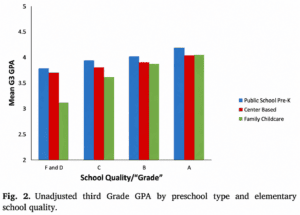
A chart from FIU researchers study on the effects of public preschool showed students’ third grade GPAs were higher among students who went to public preschool compared to subsidized private centers.
Bleiker partnered with academics at George Mason University in Virginia for the study.
The preschool data was collected about 20 years ago, following five cohorts from 2002 to 2007. Of those students studied, 18,010 went to public preschool; 9,538 attended center-based childcare, which refers to private providers, both nonprofit and for-profit; 266 had home-based learning. Bleiker said vouchers were available to all the families in the study who attended center-based childcare and home-based care, and they were used to subsidize both. The study began before Florida’s Voluntary Pre-K program rolled out in 2005, which expanded subsidized pre-K in private centers to families regardless of income. The researchers also did not follow children participating in the federally-funded Head Start program in their study.
Results took into account the child’s race, gender, poverty status, cognitive testing at age four and school quality later in life. Because of Miami-Dade’s demographics, the study also provided a lot of insight into education outcomes for Hispanic students.
“It’s a landmark study in the fact that nobody had studied a majority-Hispanic population. Normally, when they do these large-scale studies, Hispanic people are 10% or 5%. In Miami, 75% of our population is Hispanic, so that was what made it different. No one had studied quality effects of early childhood education in Miami or cities like Miami at the time or since,” Bleiker said.
In all areas the researchers tested, those who went to public preschool outperformed their peers who attended a center-based childcare facility. The numbers were even more stark when the researchers compared public preschool attendees to those who got subsidized home-based learning.
Bleiker said the results speak to the benefits of public preschool’s steadiness compared to its private peers, which can vary more in quality.
“A stable system for a high-poverty family — a connected system — works a lot better. So if you’re in center-based care, and you move from one mom-and-pop center, even if it’s the YMCA, to another, you can fall through the cracks, and you just may get lost. … But if you’re within the public-school system, that helps you continue to be connected,” Bleiker said.
The advantages for the third-graders who attended public preschool were present in state testing scores for reading and math as well as overall grade point average. Bleiker says an important takeaway from the study is that children who don’t have access to quality preschool may continue to find themselves at a disadvantage academically.
“It’s contrary to what some people want to think: ‘We can neglect the early years because we just give them high quality elementary, and that’s going to catch everybody up,’” Bleiker said.