

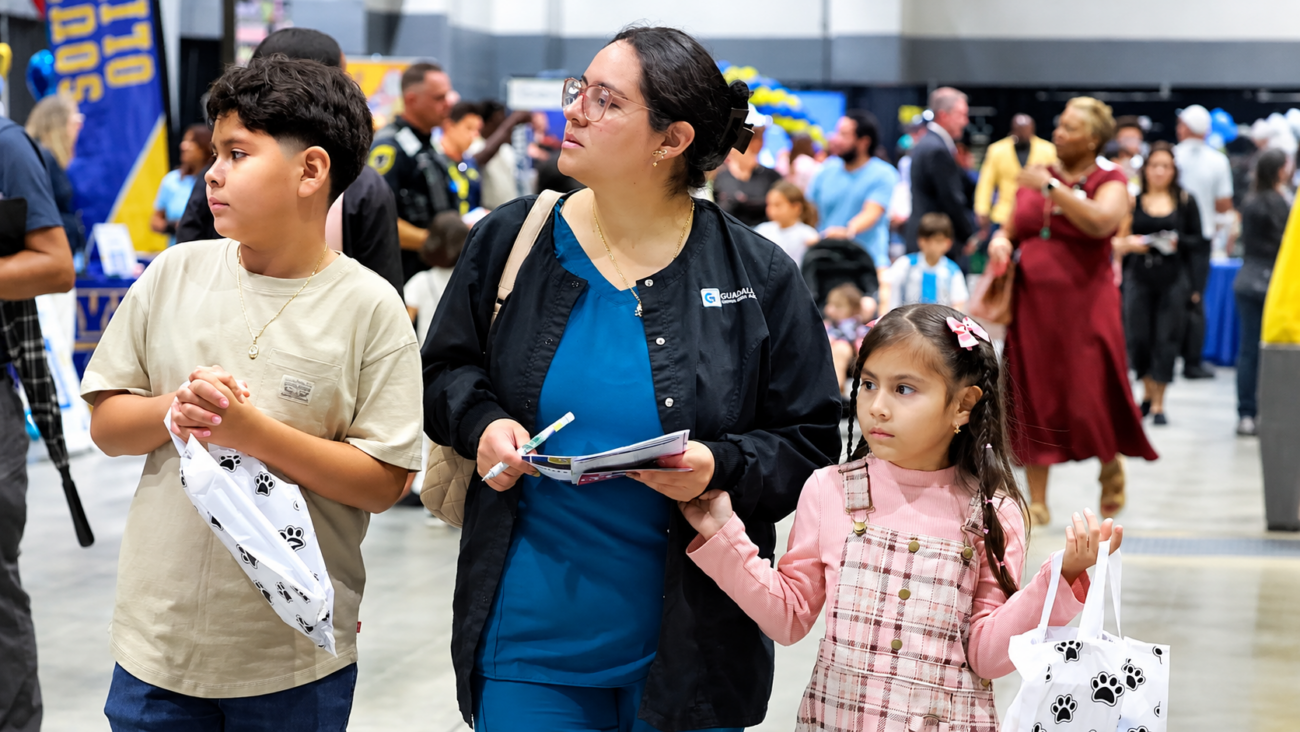
The fight for students: South Florida public schools try a new kind of recruitment
South Florida Sun Sentinel | By: Lois K. Solomon | October 8, 2026
Come back, kids!
Trying to reverse steep drops in South Florida public schools’ enrollment, administrators are brainstorming new efforts to lure students back.
Schools in Palm Beach and Broward counties say they have so much to offer, including engineering, sports management, International Baccalaureate and skilled trades programs. But some families are still choosing to go elsewhere.
Broward has been losing students for more than a decade. Palm Beach County was once an exception, with the number of students rising or remaining steady from 2021 to 2024. But last year, enrollment dropped by about 7,800.
Fewer students means less money from the state, which awards funds to each school district— about $9,338 per student, and more if the child has special needs. With reduced dollars available, Broward has been forced to close schools. Palm Beach County has also started taking steps to lessen costs, including cutting 244 positions.
It’s no longer the case that children automatically attend their neighborhood school. With so many options and changing demographic patterns, schools now have to work not only to keep families but also to find new students and bring back the ones who left.
These changes have forged a new mindset among school officials, one that would be unfamiliar to principals of 50 years ago.
“Public schools have not had to be very competitive,” said Sean Cooley, Palm Beach County’s chief of communications and enrollment. “It’s not something we had to talk about.”
Among the new initiatives the districts hope will keep them competitive: enticing academic programs such as fine arts and artificial intelligence; making phone calls to individual families whose children attend elsewhere; and having principals become more visible in neighborhoods around their schools.
Representatives from Suncoast High School in Riviera Beach speak with potential students during the Palm Beach County Annual Showcase of Schools in West Palm Beach.
Reasons for the exodus
One relatively recent phenomenon that has helped foment student departures: In 2023, taxpayer-funded vouchers that help pay for education at private and other schools, worth as much as $10,000, became available to Florida families regardless of income. About 15% of K-12 students in Florida are using these vouchers for private education, according to the Foundation for Florida’s Future, a public policy organization.
Experts cite several other reasons for declining enrollment, including lower birth rates, shifting migration patterns, the region’s high cost of living, and the COVID-19 pandemic.
“The pandemic changed how families think about schooling,” said Colin Roche, academic dean at St. Thomas University in Miami Gardens. “It made many parents more open to re-evaluating whether the traditional public school setting was the best fit for their child. And perception matters a great deal. Families are paying attention not only to academic quality, but also to school safety, school climate, communication, and whether they feel their child is
Broward schools last year surveyed parents who had withdrawn their children to find out the reasons. Among the top concerns: Dissatisfaction with the quality of education and worries about safety. Parents also mentioned frustration with school leadership, limited extracurricular activities and inadequate special education services.
Broward County
When Principal Shawn Aycock started in 2022 at Pines Collegiate Academy 6-12, a public school in Pembroke Pines, she was surprised by the sparse enrollment: 540 on a campus with room for 1,700.
She said the neighborhood around the school has been dealing with several challenges, including robust competition from Pembroke Pines Charter Schools; South Florida’s high cost of living, which has forced many families who live in nearby apartments to move; and immigration enforcement, which has spurred the removal of several families out of the country.
Aycock said she has been working hard to create appealing programs that will encourage families to choose the school, including aeronautics, dance and robotics. Enrollment is now at 831.
Although Pines Collegiate’s student body has grown a bit, enrollment in Broward public schools, including charter schools, fell by 12,343 students this year to 224,324. Broward has closed seven schools over the past two years, and Superintendent Howard Hepburn has recommended shuttering 10 more after this year.
Even as the district develops closure plans, Hepburn said his staff is working to get kids to come back. Strategies include:
• Social media posts and news stories about the district’s successes in neighborhood publications
• Appearances by principals at local festivals
• Outreach to individual families by a communications firm. The School Board in May approved a contract with Caissa Public Strategy, based in Memphis, to contact families whose children are not enrolled in the district
• Marketing to students in Palm Beach and Miami-Dade counties. Florida law allows families from any county to enroll in a public school with available seats. Miami-Dade schools have 2,084 Broward students on its campuses this year, Miami-Dade schools spokesman Elmo Lugo said.
Hepburn said there’s one place the district won’t be advertising to find students: television.
“TV campaigns don’t work,” Hepburn said. “People are getting their media from other sources now.”
Coordinator Daisy Lord, with John I. Leonard High in Greenacres, discusses her school with Stephanie Garcia Lopez during Palm Beach County’s annual Showcase of Schools on Tuesday, Oct. 6, 2026.
Palm Beach County
The Palm Beach County School District, which has 183 schools, retooled its 10-year-old Welcome Center, a resource hub that helped transition immigrant families into the public school system, as the Office of Admissions & Family Experience on July 1.
“We now provide support to American families, with a focus on student recruitment,” Cooley said.
Palm Beach County hasn’t had to close any schools, but administrators saw declining enrollment trends and realized they had to act. The student count fell by 7,219 this year to 173,155, district data shows.
At the same time, enrollment in Palm Beach County private schools continues to grow. The Diocese of Palm Beach reports a 3% increase over last year at its 15 Catholic schools, for a total of 6,815 students, according to spokeswoman Jennifer Trefelner.
Among Jewish schools, there are now 12 in south Palm Beach County, up from four in 2015, said Rabbi Josh Broide, director of the Silver Foundation, which works to foster Jewish continuity. He said all have waiting lists.
In Palm Beach County’s public system, the new admissions office is working on strategies for each of the district’s 110 schools that are at 80% capacity or less. Though still in formation, preliminary plans include:
• Evaluating the competition for student enrollment at each school and identifying what each needs to do to attract new and returning families
• Providing admissions coordinators to work one on one with families and help them enroll
• Launching PBC FlexAcademy, a part-time program for homeschool students and state scholarship recipients, who can take individual on-campus classes such as band, chorus, science and foreign languages
• Marketing programs to families in neighboring counties. “Many families near our county lines already work and commute in Palm Beach County,” school district spokesman Steve King said.
Will it work?
Palm Beach County School District officials believe their efforts to drill up enthusiasm are working: They said about 11,000 people on Oct. 6 attended their annual Showcase of Schools, where administrators and students from more than 125 campuses touted their academics, arts and athletics options.
Some parents revel in South Florida’s many options, splitting their kids between public and private academies. Plantation resident Candice D’Angelo’s seventh-grader goes to a Catholic school, and her first- and fourth-graders attend a public school.
She described her youngest’s public elementary school as “beautiful, clean and bright, a feel-good place.” He also has a specialized education plan for speech and other impairments, which she believes a public school can best accommodate.
But she said she gave her oldest son a choice about where to go for middle school, and he chose Catholic. And she believes the rigors of Catholic school will work best for her middle son next year.
D’Angelo isn’t sure how successful the school systems’ recruitment efforts will be.
“They’ve got their work cut out for them,” she said. “Parents don’t want to keep moving their kids back and forth.”
Some parents are steadfast in their belief that public schools are not for them.
Coral Springs resident Lindsay Poveromo-Joly homeschools her fifth-grade daughter and ninth-grade son. She said her son started in public schools, but she became disillusioned during the COVID-19 pandemic, when she believes schools reopened without sufficient safety guarantees. Around the same time, her daughter was diagnosed with dyslexia, and the family decided home and virtual school would be best for all.
“I plucked both kids out,” she said. “My son is able to deep-dive his passions more now. My daughter is able to get a specialized learning method.”
Poveromo-Joly, a graduate of Marjory Stoneman Douglas High in Parkland, said she never imagined herself as a homeschooling parent but needed to do what would work for her kids.
“There is no one-size-fits-all,” she said. “It’s worth having a conversation instead of pointing fingers.”